Best Countries to Study Biomedical Engineering
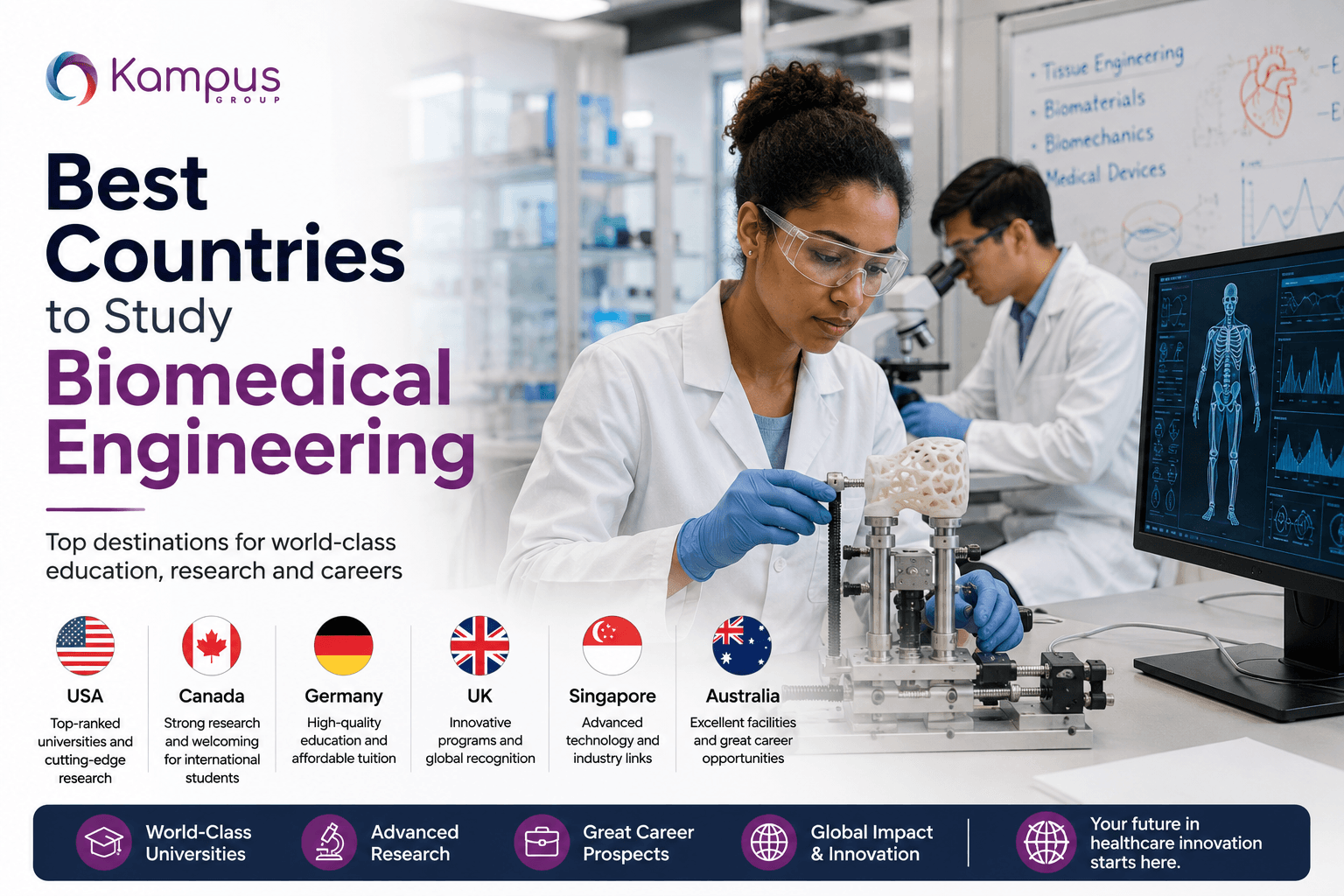
Biomedical Engineering sits at the intersection of engineering, medicine, biology, and technology. It is the field behind many of the technologies used in modern healthcare, from medical imaging and prosthetic limbs to wearable devices, surgical systems, implants, and diagnostic equipment.
For international students who enjoy both science and technology, Biomedical Engineering can offer a way to work on problems that directly affect human health.
However, where you study matters.
The strongest destinations combine excellent engineering and medical schools with research laboratories, hospitals, medical-device companies, biotechnology industries, and opportunities for practical experience. Current 2026 study-abroad guides consistently identify countries such as the USA, Germany, UK, Canada, Australia, Singapore, Switzerland, the Netherlands, Sweden, and South Korea among the leading destinations for Biomedical Engineering.
Research output also shows the importance of several of these countries in global Biomedical Engineering research. The Nature Index currently tracks research performance in the field using publications from May 2025 through April 2026.
So, which countries should international students consider?
1. United States
The United States is one of the world’s strongest destinations for Biomedical Engineering.
Its major advantage is the combination of engineering, medicine, biotechnology, healthcare, and technology.
Universities such as MIT, Johns Hopkins, Stanford, Georgia Tech, and the University of California system have major strengths in biomedical engineering and related fields. The country also has extensive medical research infrastructure and a large medical-device and biotechnology industry.
Students can explore areas such as:
- Medical imaging
- Biomaterials
- Tissue engineering
- Neural engineering
- Prosthetics
- Medical devices
- Biomedical robotics
- Artificial intelligence in healthcare
- Regenerative medicine
Why study Biomedical Engineering in the USA?
- World-class engineering and medical institutions
- Advanced biomedical laboratories
- Strong medical-device industry
- Major biotechnology ecosystem
- Extensive research opportunities
- Strong startup and innovation environment
- Wide range of specializations
The main challenge is cost. Tuition and living expenses can be substantial for international students, particularly at private universities.
The USA is particularly attractive if you want to pursue advanced research, medical technology, biotechnology, or healthcare innovation.
2. Germany
Germany is a strong option for students who want to combine Biomedical Engineering with advanced engineering and industrial research.
The country’s engineering reputation, research institutions, medical technology sector, and manufacturing expertise create a strong environment for biomedical innovation.
German universities and research organizations work across areas including medical imaging, biomechanics, biomaterials, rehabilitation technology, medical devices, and biomedical systems.
Why study Biomedical Engineering in Germany?
- Strong engineering education
- Advanced research infrastructure
- Medical technology industry
- Strong university-industry collaboration
- Research opportunities
- Relatively attractive public-university tuition structures at many institutions
Germany can be particularly interesting for students who want to connect engineering with practical medical applications.
International students should still check the tuition and semester-fee requirements of each institution because costs vary according to the university, state, and student status.
3. United Kingdom
The UK has a strong reputation for biomedical research and engineering.
Universities such as Imperial College London, University College London, the University of Oxford, and the University of Cambridge provide access to major research ecosystems spanning medicine, engineering, biotechnology, and healthcare.
The UK also has important life-sciences and medical-technology clusters, creating opportunities for students interested in research and industry.
Why study Biomedical Engineering in the UK?
- Strong biomedical research
- Excellent engineering universities
- Access to medical research environments
- Biotechnology and med-tech ecosystem
- Strong postgraduate programs
- Interdisciplinary research opportunities
The UK’s relatively short degree structures can also be attractive to international students who want to complete their studies in less time than some comparable programs.
The main consideration is cost, particularly international tuition at highly ranked universities.
4. Canada
Canada is another strong destination for Biomedical Engineering, particularly for students interested in healthcare innovation, medical research, biotechnology, and engineering.
Universities such as the University of Toronto, University of British Columbia, McGill University, McMaster University, and University of Waterloo offer relevant programs and research opportunities.
Canada also has a growing life-sciences and biotechnology ecosystem.
Why study Biomedical Engineering in Canada?
- Strong engineering and medical research
- Biomedical and biotechnology innovation
- Research-focused universities
- Opportunities for interdisciplinary study
- Co-op and practical-learning opportunities at some institutions
- Multicultural environment
Canada can be particularly appealing to students interested in combining engineering, healthcare, and research.
International students should investigate current study-permit and post-graduation work rules carefully, as immigration policies can change.
5. Australia
Australia is a strong destination for students interested in Biomedical Engineering and related fields.
Universities including the University of Melbourne, University of Sydney, Monash University, and UNSW Sydney have strong engineering and biomedical research capabilities. Current study-abroad data also places Australia among the leading destinations for Biomedical Engineering programs.
Australian research covers areas such as medical devices, rehabilitation, biomaterials, biomedical imaging, biotechnology, and health technology.
Why study Biomedical Engineering in Australia?
- Strong engineering universities
- Advanced research facilities
- Biomedical and biotechnology research
- Medical technology opportunities
- Strong links between universities and industry
- English-speaking academic environment
Australia can be particularly attractive to students who want to study medical technology while gaining international experience in the Asia-Pacific region.
6. Singapore
Singapore has developed a strong reputation as a technology, healthcare, and biomedical research hub in Asia.
Its small size allows universities, research institutions, healthcare organizations, government agencies, and technology companies to operate within a highly connected ecosystem.
Students can explore areas such as:
- Biomedical devices
- Bioengineering
- Medical imaging
- Biotechnology
- Nanotechnology
- Healthcare AI
- Biomedical data
- Tissue engineering
Why study Biomedical Engineering in Singapore?
- Strong technology ecosystem
- Advanced healthcare infrastructure
- Biomedical research
- Biotechnology industry
- Strong university-industry connections
- Strategic location in Asia
Singapore is particularly suitable for students interested in the intersection of Biomedical Engineering, technology, and healthcare innovation.
7. Switzerland
Switzerland offers a highly research-intensive environment for Biomedical Engineering.
Institutions such as ETH Zurich and EPFL are known for their strengths in engineering, life sciences, robotics, materials, and advanced technology.
The country’s pharmaceutical and medical-technology industries also provide an important environment for biomedical innovation.
Why study Biomedical Engineering in Switzerland?
- Excellent engineering education
- Strong biomedical research
- Advanced laboratories
- Medical robotics
- Biomaterials and biomechanics
- Strong pharmaceutical and healthcare ecosystem
- High-level research opportunities
Switzerland is particularly attractive for students interested in research-intensive Biomedical Engineering, robotics, medical devices, and advanced technologies.
The major drawback is the relatively high cost of living.
8. Netherlands
The Netherlands is another strong European destination for Biomedical Engineering.
Its universities combine engineering, technology, life sciences, and healthcare research, while the country has a strong reputation for applied innovation.
Universities such as Delft University of Technology, Eindhoven University of Technology, and the University of Twente are associated with engineering and biomedical research.
Why study Biomedical Engineering in the Netherlands?
- Strong engineering education
- Applied research
- Medical technology
- Biomedical robotics
- Strong technology ecosystem
- Many English-taught programs
- Connections with European research networks
The Netherlands can be a particularly good choice if you want to combine Biomedical Engineering with robotics, imaging, materials, or medical technology.
9. Sweden
Sweden is well known for innovation, engineering, healthcare technology, and research.
Universities such as KTH Royal Institute of Technology, Lund University, and Chalmers University of Technology offer opportunities in biomedical engineering and related fields.
Sweden’s technology ecosystem also creates opportunities to explore the intersection between engineering and healthcare.
Why study Biomedical Engineering in Sweden?
- Strong engineering education
- Health-technology research
- Medical imaging
- Biomedical systems
- Innovation-focused environment
- Strong sustainability focus
- English-taught postgraduate opportunities
Sweden can be especially appealing to students interested in health technology, medical devices, research, and innovation.
10. South Korea
South Korea has built a highly advanced technology and manufacturing ecosystem, making it increasingly relevant to Biomedical Engineering.
The country combines electronics, artificial intelligence, biotechnology, robotics, advanced manufacturing, and healthcare technology.
Universities such as KAIST, Seoul National University, and POSTECH provide strong research environments for students interested in technology-intensive biomedical applications.
Why study Biomedical Engineering in South Korea?
- Advanced technology sector
- Strong electronics industry
- Biotechnology research
- Medical robotics
- Wearable technology
- AI and healthcare
- Advanced research laboratories
South Korea is particularly interesting for students who want to combine Biomedical Engineering with AI, electronics, robotics, or wearable technology.
Which Country Is Best for Biomedical Engineering?
There is no single best country for every student.
Your ideal destination depends on the specialization you want, your budget, and the type of career you want after graduation.
Best for Biomedical Engineering Research
USA, UK, Switzerland, Germany
These countries offer strong research universities and advanced laboratories.
Best for Medical Devices
USA, Germany, Switzerland, Netherlands
These destinations have strong engineering and medical-technology ecosystems.
Best for Biomedical AI and Digital Health
USA, Singapore, UK, Canada, South Korea
These countries provide strong intersections between AI, computing, healthcare, and engineering.
Best for Biomedical Robotics
Switzerland, USA, Germany, Netherlands, South Korea
These countries are particularly relevant if you are interested in robotics, prosthetics, rehabilitation, and intelligent medical systems.
Best for Biotechnology
USA, UK, Germany, Australia, Singapore
These countries have strong biotechnology and life-sciences research ecosystems.
What Do You Study in Biomedical Engineering?
Biomedical Engineering is highly interdisciplinary.
Depending on your university and specialization, you may study:
- Mathematics
- Physics
- Biology
- Chemistry
- Human anatomy
- Physiology
- Materials science
- Electronics
- Programming
- Biomechanics
- Biomaterials
- Medical imaging
- Signal processing
- Control systems
- Artificial intelligence
- Tissue engineering
- Medical-device design
This combination means students need to be comfortable working across both engineering and biological sciences.
Popular Biomedical Engineering Specializations
Biomedical Engineering is broad enough that students can eventually specialize in a particular area.
Medical Devices
Design and develop technologies such as monitoring equipment, diagnostic devices, surgical tools, and implants.
Biomaterials
Study materials that can safely interact with the human body.
Biomechanics
Use engineering principles to understand movement and the mechanical behavior of the human body.
Tissue Engineering
Explore ways of repairing or replacing damaged tissues using biological and engineering approaches.
Medical Imaging
Work with technologies that help doctors visualize structures and processes inside the body.
Neural Engineering
Develop technologies that interact with the nervous system, including neural interfaces and assistive technologies.
Rehabilitation Engineering
Design technologies that help people recover movement or live more independently.
Biomedical AI
Apply machine learning and data analysis to medical imaging, diagnostics, monitoring, and healthcare systems.
What Skills Should Biomedical Engineering Students Develop?
A strong Biomedical Engineering student should develop more than theoretical knowledge.
Programming and Data Skills
Python, MATLAB, statistics, data analysis, and machine learning can be useful depending on your specialization.
Engineering Design
Learn how to design, prototype, test, and improve biomedical technologies.
Laboratory Skills
Practical laboratory experience can be particularly valuable for students interested in research and biotechnology.
Communication
Biomedical engineers often work with doctors, researchers, engineers, patients, and business professionals.
The ability to explain technical concepts clearly is therefore important.
Problem-Solving
The field is ultimately about solving real healthcare problems.
Students should learn how to move from identifying a problem to developing, testing, and improving a potential solution.
What Should International Students Consider Before Choosing a University?
Choosing a country is only the first step.
The specific university and program matter just as much.
Before applying, investigate:
- Course curriculum
- Specialization options
- Research laboratories
- Hospital partnerships
- Industry connections
- Internship opportunities
- Capstone projects
- Tuition fees
- Scholarships
- Cost of living
- Language requirements
- Professional accreditation where relevant
- Post-study work opportunities
It is also important to determine whether the degree is designed primarily for research, industry, clinical applications, or further postgraduate study.
A student planning to develop medical devices may want a very different program from someone planning to pursue biomedical research.
Career Opportunities in Biomedical Engineering
Biomedical Engineering graduates can work across healthcare, technology, research, and manufacturing.
Potential careers include:
- Biomedical engineer
- Medical-device engineer
- Clinical engineer
- Biomaterials engineer
- Rehabilitation engineer
- Biomechanics engineer
- Biomedical research scientist
- Medical imaging specialist
- Healthcare technology specialist
- Regulatory affairs specialist
- Biomedical data scientist
- Biotechnology engineer
- Product development engineer
Graduates can find opportunities in:
- Medical-device companies
- Hospitals
- Biotechnology companies
- Pharmaceutical companies
- Research institutes
- Universities
- Healthcare technology companies
- Government agencies
- Engineering firms
- Startups
The US Bureau of Labor Statistics projects employment of bioengineers and biomedical engineers in the United States to grow from 2024 to 2034, illustrating the continuing demand for professionals in the field.
Frequently Asked Questions
Which country is best for studying Biomedical Engineering?
The USA, Germany, UK, Canada, Australia, Singapore, Switzerland, Netherlands, Sweden, and South Korea are among the leading destinations. The best choice depends on your specialization, budget, preferred research environment, and career goals.
Is Biomedical Engineering a good degree for international students?
Yes. Biomedical Engineering can be a strong option for students interested in engineering, healthcare, biotechnology, medical devices, AI, and research. However, students should research employment and work-authorization opportunities in their chosen country.
Which country is best for Biomedical Engineering research?
The USA, UK, Germany, and Switzerland are particularly strong choices for students interested in research-intensive Biomedical Engineering.
Which country is best for medical-device engineering?
Germany, the USA, Switzerland, and the Netherlands are strong choices because of their engineering expertise and medical-technology ecosystems.
Is Biomedical Engineering difficult?
It can be demanding because it combines engineering, mathematics, biology, physics, chemistry, and sometimes programming. Students who enjoy interdisciplinary problem-solving are generally well suited to the field.
Do I need to study medicine to become a Biomedical Engineer?
No. Biomedical Engineering is an engineering discipline that applies engineering principles to healthcare and biological problems. You do not need to become a doctor to work in the field.
What subjects should I study before Biomedical Engineering?
Mathematics, Physics, Biology, Chemistry, and Computer Science can provide a strong foundation. Exact admission requirements vary between universities.
Can Biomedical Engineers work in hospitals?
Yes. Some Biomedical Engineers work in hospitals as clinical engineers or in roles involving medical equipment, technology management, safety, and healthcare systems.
Can Biomedical Engineering lead to a career in medical devices?
Yes. Medical-device development is one of the major career areas within Biomedical Engineering. Graduates can work on design, testing, manufacturing, quality, regulatory processes, and product development.

Written by
Fimijoba Micheal Oladokun is an International Student Consultant, SEO Specialist and Technical Writer at Kampus Group Nigeria. He leverages data-driven insights to support strategic decision-making while guiding prospective international students through admissions and study abroad processes. He also creates clear, SEO-optimized technical content that enhances digital engagement and simplifies complex educational topics.
Get a free, unbiased assessment from a Kampus Group advisor — no obligation, completely free.
More on Destinations

Best 10 UK Universities for International Students in 2027
Choosing the right university is one of the most important decisions you will make when planning to study in the United Kingdom. With hundreds of institutions offering undergraduate and postgraduate programmes, internati
10 Oct 2026
How Much Does It Cost to Study a Master’s in the UK in 2027?
Studying for a master’s degree in the United Kingdom can be an important investment in your education and career. However, before applying, it is essential to understand the full cost of studying abroad. For internationa
10 Oct 2026
Can International Students Work While Studying in the UK?
Studying in the United Kingdom can provide international students with access to quality education, professional networks and opportunities to gain work experience. For many students, working part-time is also a way to h
10 Oct 2026