How International Students Can Build a Global Professional Brand Online
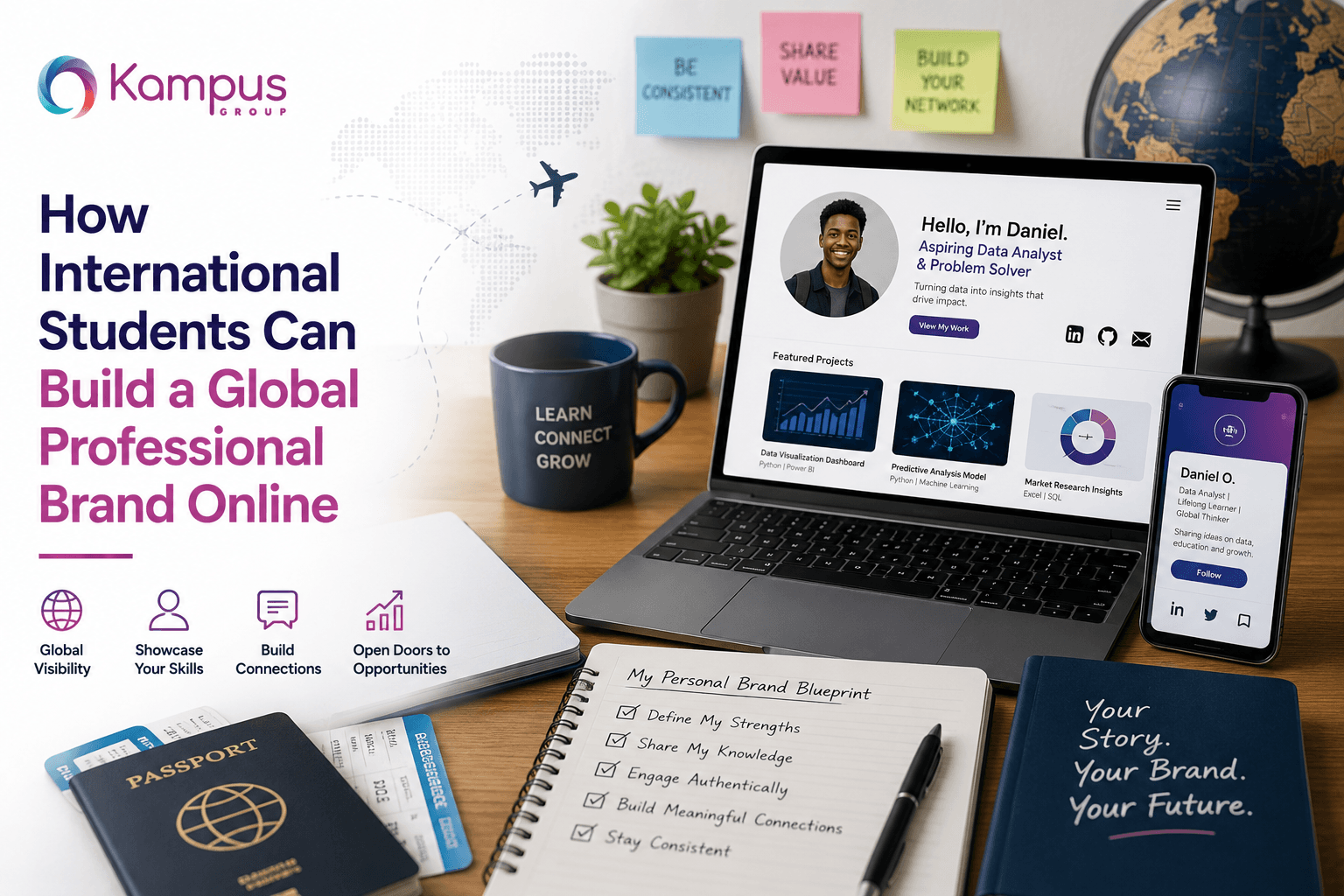
Studying abroad can give you access to a new academic environment, international classmates, different industries, and a wider professional network.
But your professional identity is no longer limited to the people you meet on campus.
Employers, recruiters, researchers, universities, and potential business partners can discover you online long before they meet you in person.
This makes your online professional brand increasingly important.
For international students, building a professional brand online can be especially valuable. Your digital presence can help you communicate your skills, experiences, interests, and international perspective to people across different countries and industries.
However, professional branding is not about becoming an internet celebrity.
It is about making it easy for the right people to understand who you are, what you can do, what you are interested in, and why they should take you seriously.
What Is a Global Professional Brand?
Your professional brand is the way people perceive you based on your skills, experience, interests, achievements, communication, and professional presence.
Your online professional brand can include:
- LinkedIn profile
- Personal website
- Online portfolio
- GitHub profile
- Research profiles
- Professional social-media accounts
- Published articles
- Academic projects
- Certifications
- Conference participation
- Professional communities
A global professional brand takes this one step further.
It communicates your value to people who may come from different countries, industries, cultures, and professional backgrounds.
For an international student, this can help transform your study-abroad experience into a professional advantage.
1. Define What You Want to Be Known For
Before changing your LinkedIn profile or creating a website, decide what you want your professional identity to communicate.
Ask yourself:
What field am I interested in?
What skills do I want employers to associate with me?
What type of opportunities am I looking for?
For example, instead of presenting yourself simply as:
“International student studying Engineering”
you could position yourself around a clearer area of interest:
“Engineering student interested in renewable energy, sustainable manufacturing, and clean technology.”
The second statement gives people a much better understanding of your professional direction.
You do not need to know exactly what your career will look like.
Your professional brand can evolve as you gain experience.
2. Build a Strong LinkedIn Profile
For many students, LinkedIn should be the foundation of their professional online presence.
Your profile should clearly communicate:
- Who you are
- What you study
- Your areas of interest
- Your relevant skills
- Your experience
- Your achievements
- The type of opportunities you are pursuing
Start With Your Headline
Your headline should say more than:
“Student at XYZ University.”
Instead, consider including your field, specialization, and interests.
For example:
Biomedical Engineering Student | Medical Devices | Healthcare Technology | Research
This makes your professional direction immediately clearer.
3. Write a Useful About Section
Your About section should tell your professional story.
A simple structure is:
Who you are
Briefly introduce yourself and your academic background.
What interests you
Explain the subjects, industries, or problems you are interested in.
What you have done
Mention relevant projects, internships, research, leadership experiences, or achievements.
What you are looking for
Explain the types of opportunities you are interested in.
Keep it readable.
Large blocks of text can make your profile difficult to scan.
4. Make Your International Experience Part of Your Story
Studying abroad is more than a line on your CV.
It can demonstrate:
- Adaptability
- Independence
- Cross-cultural communication
- Resilience
- International experience
- Collaboration
- Exposure to different perspectives
But simply writing “I studied abroad” does not communicate the full value.
Explain what you actually learned.
For example:
Instead of:
“Studied in Canada.”
You could communicate:
“Completed engineering coursework in a multicultural academic environment while collaborating with students from multiple countries on design projects.”
The second version demonstrates a skill rather than simply stating an experience.
5. Showcase Your Projects
Students often underestimate the value of projects.
You do not need years of professional experience to demonstrate what you can do.
Academic and personal projects can provide evidence of your skills.
Depending on your field, you could showcase:
- Research projects
- Engineering designs
- Software applications
- Business plans
- Data-analysis projects
- Marketing campaigns
- Architectural designs
- Research papers
- Case studies
- Sustainability projects
- Product prototypes
For each project, explain:
What was the problem?
What did you do?
What tools or skills did you use?
What was the result?
This turns a project from a title into evidence of your capabilities.
6. Create an Online Portfolio
A portfolio can be particularly valuable for students in technical and creative fields.
Your portfolio could include:
- Project summaries
- Research work
- Design work
- Writing samples
- Data visualizations
- Software projects
- Case studies
- Presentations
- Publications
Keep the design simple.
The goal is not to create the most complicated website.
The goal is to make your work easy to understand.
Someone should be able to visit your portfolio and quickly answer:
What does this person do?
What have they worked on?
What can they contribute?
7. Use GitHub If You Are in Technology
For students studying Computer Science, Software Engineering, Data Science, AI, or related disciplines, GitHub can provide evidence of technical ability.
Instead of simply listing:
Python
Java
Machine Learning
show examples of how you have used those skills.
Your GitHub profile can contain:
- Personal projects
- University projects
- Data-analysis notebooks
- Machine-learning models
- Applications
- APIs
- Automation tools
- Documentation
Make your repositories understandable.
A well-documented small project can sometimes communicate more than a large collection of unfinished repositories.
8. Share Your Research Online
Students interested in research should make their academic work discoverable where appropriate.
You might share:
- Research projects
- Conference presentations
- Posters
- Publications
- Literature reviews
- Research summaries
- Academic achievements
You can also follow researchers whose work interests you and engage thoughtfully with their work.
Avoid pretending to be an expert when you are still learning.
It is perfectly acceptable to communicate:
“I am currently exploring…”
or
“I recently learned about…”
Professional credibility grows when your online presence accurately reflects your level of expertise.
9. Create Useful Content
Content can help demonstrate your interests and expertise.
You could write about:
- Lessons from your degree
- Industry trends
- Research you are reading
- Projects you have completed
- Skills you are learning
- Challenges you solved
- Experiences studying abroad
- Insights from conferences
- Career lessons
For example, a student studying agricultural technology could write about how drones and AI are changing precision agriculture.
A Computer Science student might explain what they learned while building a machine-learning project.
A Business student could analyze an international company’s expansion strategy.
The goal is not to post every day.
The goal is to share useful evidence of how you think.
10. Avoid Trying to Be an Expert in Everything
One of the easiest ways to weaken a professional brand is to talk about everything.
Today you post about AI.
Tomorrow politics.
The next day fashion.
Then cryptocurrency.
Then football.
There is nothing wrong with having broad interests.
But if your goal is professional visibility, your public content should have some connection to the areas you want to be known for.
A focused professional identity is easier for employers and recruiters to understand.
11. Network With Professionals Around the World
Your online network does not have to be limited to your university or current country.
Connect with:
- Alumni
- Researchers
- Recruiters
- Industry professionals
- Entrepreneurs
- University staff
- Professional associations
- Students in your field
When sending a connection request, personalize it where appropriate.
Mention the shared interest, university, industry, research area, or event that gives you a reason to connect.
12. Use Your University Alumni Network
Your university can be one of your strongest sources of professional connections.
Find alumni working in the countries and industries that interest you.
For example, if you are studying engineering and want to work in Germany after graduation, look for alumni from your university who are already working there.
You can learn about:
- Career paths
- Employers
- Industry expectations
- Recruitment
- Professional culture
- Skills employers value
This can also help you expand your professional network beyond your immediate surroundings.
13. Make Your Profile Search-Friendly
Recruiters often search for candidates using specific keywords.
Make sure your profile naturally includes relevant terms associated with your field.
For example, an aspiring data professional might include relevant skills such as:
- Python
- SQL
- Data Analysis
- Machine Learning
- Statistics
- Data Visualization
Do not simply fill your profile with keywords.
Use them naturally in your headline, About section, project descriptions, education, and experience.
14. Keep Your Professional Information Consistent
Your LinkedIn profile, CV, portfolio, and other professional platforms should tell the same basic story.
Your:
- Name
- Academic background
- Experience
- Skills
- Career interests
- Project history
should not contradict one another.
You do not need identical wording everywhere.
But major information should remain consistent.
A recruiter should not see one graduation date on your CV and a completely different one on LinkedIn.
15. Develop a Professional Profile Photo
Your profile photo does not need to be expensive or professionally photographed.
It should simply be:
- Clear
- Recent
- Well-lit
- Professional
- Easy to recognize
Avoid heavily edited images, distracting backgrounds, or photographs where it is difficult to identify you.
16. Be Careful With Your Public Social Media
Your professional brand does not exist only on LinkedIn.
Recruiters or employers may encounter your other public profiles.
This does not mean you need to remove your personality from the internet.
It means you should understand what information is publicly visible.
Review:
- Public posts
- Profile descriptions
- Public photos
- Usernames
- Comments
- Public interactions
Your personal and professional identities can coexist.
The important thing is to understand what you are communicating publicly.
17. Use Your International Perspective as an Advantage
International students often have experiences that domestic candidates may not have.
You may understand:
- More than one market
- Different education systems
- Different cultures
- International consumers
- Cross-border collaboration
- Global business challenges
These experiences can become part of your professional positioning.
For example:
“I am interested in how sustainable technologies can be adapted to different markets.”
That communicates both your technical interest and your international perspective.
18. Learn to Communicate Across Cultures Online
Global networking requires cultural awareness.
Different people may have different expectations regarding:
- Formality
- Response times
- Introductions
- Professional titles
- Communication styles
- Networking etiquette
A message that feels casual in one environment may seem overly informal in another.
When contacting professionals internationally, observe how they communicate and adapt appropriately.
19. Collect Recommendations and Testimonials
Professional recommendations can strengthen your online credibility.
Consider requesting recommendations from:
- Professors
- Internship supervisors
- Project leaders
- Research supervisors
- Managers
- Professional collaborators
The best recommendations are specific.
A statement such as:
“Excellent student.”
is less useful than a recommendation describing your analytical ability, teamwork, technical skills, or contribution to a particular project.
20. Share Achievements Without Bragging
Professional branding requires visibility, but there is a difference between communicating an achievement and constantly promoting yourself.
Instead of:
“I am the best data scientist!”
share the actual accomplishment.
For example:
“Our team developed a forecasting model that improved prediction accuracy by 18% during our university project.”
Let the evidence communicate your ability.
21. Document Your Learning Journey
You do not have to wait until you have achieved something major before posting.
You can share what you are learning.
For example:
Week 1: Learning Python for data analysis.
Week 4: Completed my first data-cleaning project.
Week 8: Built a dashboard using real-world data.
This creates a visible record of development.
It also shows potential employers that you are proactive about learning.
22. Avoid Fake Expertise
One of the biggest risks of professional branding is exaggeration.
Do not claim:
- Skills you do not have
- Jobs you never held
- Projects you did not complete
- Qualifications you do not possess
- Research you did not conduct
Your digital footprint can follow you for years.
Build your reputation on evidence.
It is better to be known as a capable student who is actively developing than as an “expert” whose claims cannot be verified.
23. Build Your Brand Before Graduation
Do not wait until your final semester.
Start early.
First year
Focus on learning, exploring interests, and building your basic profile.
Second year
Start developing projects, joining professional communities, and connecting with alumni.
Third year
Build stronger projects, pursue internships, participate in research, and develop a clearer professional direction.
Final year
Showcase your strongest work, actively network, apply for opportunities, and communicate your career goals.
By graduation, you should already have a professional identity rather than trying to create one overnight.
24. Measure What Is Working
You do not need to obsess over follower counts.
Instead, look at meaningful outcomes.
Ask:
- Are professionals connecting with me?
- Am I receiving relevant opportunities?
- Are recruiters viewing my profile?
- Are people engaging with my work?
- Are my posts generating useful conversations?
- Am I meeting people in my target industry?
A small network of relevant professionals can be more valuable than thousands of unrelated followers.
A Simple Global Professional Branding Strategy
If you are starting from scratch, follow this sequence.
Step 1: Choose your professional direction
Identify your field and 2–3 areas you want to be associated with.
Step 2: Improve LinkedIn
Create a clear headline, About section, experience section, and skills profile.
Step 3: Build evidence
Document projects, research, internships, competitions, and achievements.
Step 4: Create a portfolio
Show your best work in one accessible place.
Step 5: Build your network
Connect with alumni, professionals, researchers, and recruiters.
Step 6: Share useful content
Write about what you are learning, building, researching, or observing.
Step 7: Keep everything consistent
Make sure your CV, LinkedIn, portfolio, and other professional profiles tell a coherent story.
Step 8: Keep improving
Your professional brand should evolve as your skills and career interests develop.
Frequently Asked Questions
What is a professional brand?
A professional brand is the perception people develop about your skills, experience, interests, expertise, and professional value. Your online presence is one of the main ways people form that perception.
Why is a professional brand important for international students?
It can help international students become more visible to employers, recruiters, researchers, universities, and professionals in different countries. It can also help communicate the value of international experience.
Is LinkedIn enough to build a professional brand?
LinkedIn is an excellent starting point, but it does not have to be the only platform. Depending on your field, a portfolio, GitHub profile, personal website, research profile, or other professional platform may also be valuable.
Should international students create a personal website?
A personal website can be useful, particularly for students with projects, research, writing, design work, or technical portfolios to showcase. It is not mandatory, but it can give you greater control over your professional presence.
What should international students post on LinkedIn?
Share useful and relevant content such as project experiences, research insights, lessons from your studies, industry observations, certifications, achievements, and professional development.
How can I attract international employers?
Build a profile that clearly communicates your skills, experience, projects, and career interests. Use relevant professional keywords, connect with people in your target industry, showcase your work, and participate in international professional communities.
Can studying abroad strengthen my professional brand?
Yes. International education can provide experiences involving multicultural teamwork, adaptability, international communication, and exposure to different academic or professional environments. These experiences can become part of your professional story.

Written by
Fimijoba Micheal Oladokun is an International Student Consultant, SEO Specialist and Technical Writer at Kampus Group Nigeria. He leverages data-driven insights to support strategic decision-making while guiding prospective international students through admissions and study abroad processes. He also creates clear, SEO-optimized technical content that enhances digital engagement and simplifies complex educational topics.
Get a free, unbiased assessment from a Kampus Group advisor — no obligation, completely free.
More on Career Outcomes

Can You Use a Second Master’s to Move Into Management?
Moving into management is a common career goal for professionals who want to take on greater responsibility, lead teams, manage projects, or progress into senior positions. However, moving from a technical or specialist
13 Oct 2026
How to Choose a University Based on Graduate Career Support
Choosing a university is not only about finding a good course or a highly ranked institution. For many international students, the bigger question is: What will this university do to help me build a career after graduati
1 Oct 2026
Best Countries to Study Data Science for a Global Career
Data has become one of the most valuable resources in the modern economy. Businesses, governments, financial institutions, healthcare organisations, technology companies and research institutions increasingly rely on dat
17 Sept 2026