How International Students Can Prepare for Digital Interviews
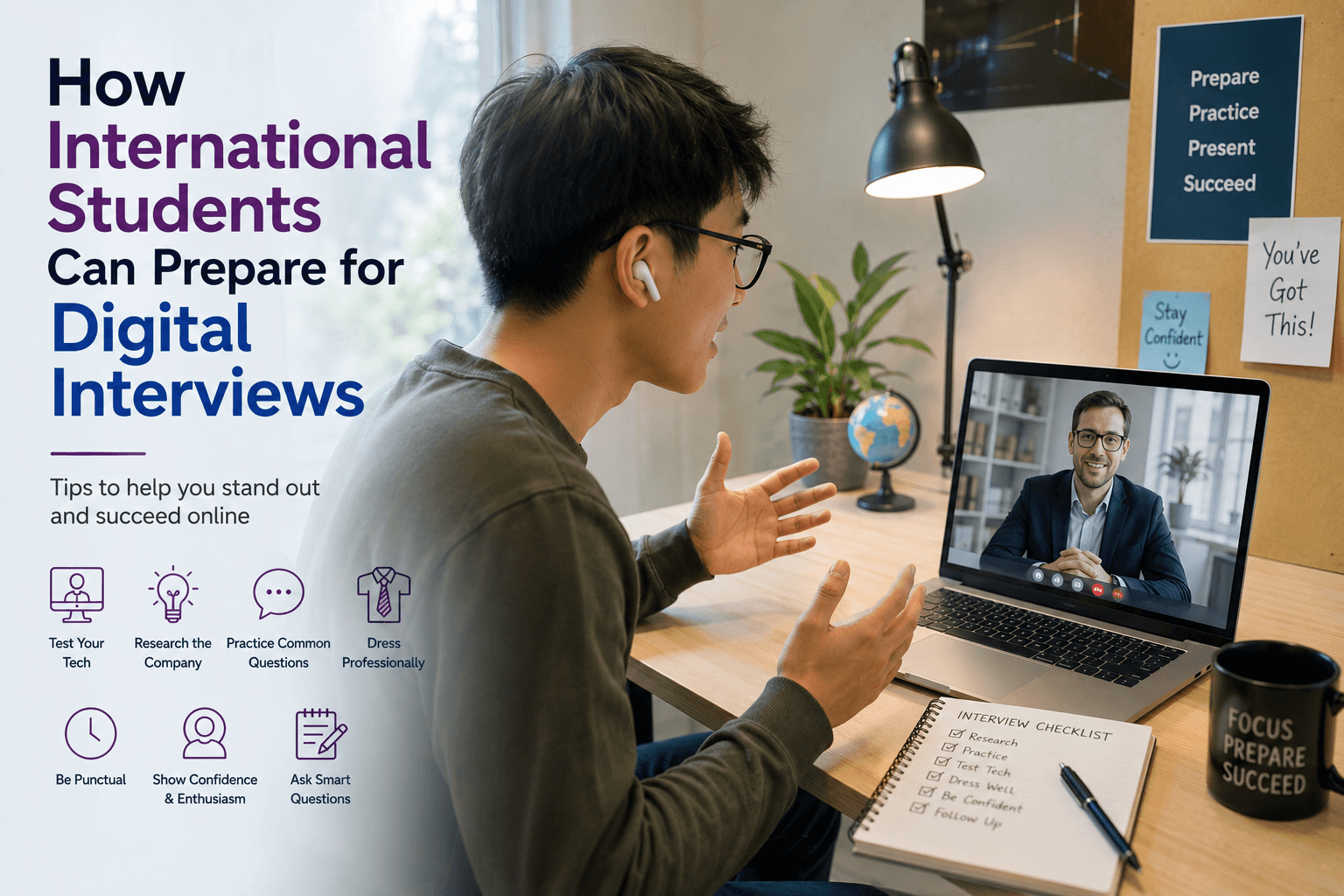
The way employers interview candidates has changed significantly.
For international students, this can be both an advantage and a challenge. You may be able to apply for internships, graduate positions, and jobs without traveling to another city or country for an interview. At the same time, digital interviews require you to manage technology, communication, presentation, and professional etiquette from a screen.
A strong CV may get you the interview, but your performance during that conversation can determine whether you move to the next stage.
Whether you are interviewing for an internship, graduate position, scholarship, research opportunity, or part-time job, preparing properly can make a significant difference.
Here is how international students can prepare for digital interviews.
1. Understand the Type of Digital Interview
Not every digital interview works the same way.
Before preparing your answers, find out what format you will be using.
Common formats include:
- Live video interviews
- Pre-recorded video interviews
- Telephone interviews
- Online assessment interviews
- Panel interviews
- Technical interviews
- Case-study interviews
A live interview allows you to interact directly with the interviewer.
A pre-recorded interview may give you a question and a limited amount of time to prepare before recording your response.
Understanding the format helps you prepare appropriately.
2. Test Your Technology Before the Interview
Technical problems can create unnecessary stress.
Before the interview, test:
- Your laptop or computer
- Camera
- Microphone
- Headphones
- Internet connection
- Video-conferencing software
- Browser
- Power supply
- Screen-sharing function, if required
Do not wait until five minutes before the interview to discover that your microphone is not working.
Perform a complete test at least a day in advance.
If possible, conduct a practice call with a friend and ask them to check how your audio and video appear.
Have a Backup Plan
Internet connections can fail.
If your primary internet connection becomes unstable, know what your alternative will be.
You might have:
- A mobile hotspot
- A second internet connection
- A backup device
- A nearby location with reliable internet
The goal is not to eliminate every possible technical problem.
It is to make sure you can recover quickly if something goes wrong.
3. Choose the Right Location
Your environment affects how professional you appear.
Choose a quiet location with:
- Good lighting
- Minimal background noise
- A stable internet connection
- A clean background
- Comfortable seating
- Few distractions
Avoid sitting somewhere where people are constantly walking behind you or where background noise makes conversation difficult.
If your environment is not ideal, use a professional virtual background if the interview platform supports one and you can run it smoothly.
However, a clean physical background is often preferable.
4. Pay Attention to Lighting
Your face should be clearly visible.
The best setup is usually to have your main light source in front of you, rather than directly behind you.
A window in front of you can provide natural light, although direct sunlight may create harsh shadows.
Avoid sitting with a bright window directly behind you because the camera may expose for the window and make your face appear dark.
A simple desk lamp positioned appropriately can also improve your image.
5. Position Your Camera Correctly
Camera position can influence how confident and professional you appear.
Ideally:
- Place the camera around eye level
- Keep your face clearly visible
- Frame your head and shoulders comfortably
- Avoid positioning the camera too close
- Keep the camera stable
Looking directly into the camera when speaking can help create the impression of eye contact.
This can feel unnatural at first.
Practice it before the interview.
6. Research the Employer
Digital interviews require the same level of preparation as in-person interviews.
Research the organization before the conversation.
Learn about:
- What the company does
- Its products or services
- Its industry
- Recent developments
- Company culture
- The position
- Required skills
- The people interviewing you, when their identities are provided
You should be able to explain why you are interested in the organization.
Avoid giving an answer that could apply to every company.
Instead, connect your interests and experience to the specific organization.
7. Study the Job Description Carefully
The job description often tells you what the interviewer is likely to ask about.
Look for repeated requirements such as:
- Communication
- Leadership
- Teamwork
- Data analysis
- Programming
- Customer service
- Problem-solving
- Research
- Project management
For each major requirement, prepare an example demonstrating that skill.
This is more effective than memorizing generic answers.
8. Prepare Your Introduction
Many interviews begin with a simple question:
“Tell me about yourself.”
Prepare a concise professional introduction.
A useful structure is:
Present → Past → Future
Start with what you are currently studying or doing.
Then briefly mention relevant experience or achievements.
Finally, explain what you are looking for and why the opportunity interests you.
Keep it focused.
The interviewer does not need your entire life story.
9. Prepare Examples Using the STAR Method
Behavioral interview questions often ask you to describe situations from your experience.
For example:
- “Tell me about a time you solved a difficult problem.”
- “Describe a time you worked in a team.”
- “Tell me about a time you dealt with failure.”
- “Give an example of when you demonstrated leadership.”
The STAR method can help structure your answers:
Situation: What was happening?
Task: What were you responsible for?
Action: What did you do?
Result: What happened because of your actions?
Whenever possible, include measurable results.
Instead of saying:
“I helped with a university project.”
You could explain what problem the project addressed, what you personally contributed, and what outcome the team achieved.
10. Practice Speaking Clearly
International students may sometimes worry about accents.
An accent is not automatically a problem.
What matters is whether you can communicate clearly and effectively.
During your interview:
- Speak at a moderate pace
- Avoid rushing
- Pronounce important terms clearly
- Pause before answering difficult questions
- Avoid unnecessary filler words
- Ask for clarification when necessary
If you do not understand a question, it is perfectly acceptable to say:
“Could you please clarify what you mean by that?”
That is better than answering a completely different question.
11. Don’t Try to Hide Your Accent
International students sometimes try to completely change the way they speak before an interview.
That can make communication feel unnatural.
Your objective should be clarity, not accent elimination.
Speak naturally while making sure the interviewer can understand you comfortably.
Confidence and clear communication matter more than sounding exactly like a native speaker.
12. Pay Attention to Body Language
The interviewer can still see many aspects of your body language through a webcam.
Try to:
- Sit upright
- Maintain appropriate eye contact
- Smile naturally
- Nod when listening
- Avoid excessive movement
- Keep your hands reasonably controlled
- Look engaged
Avoid constantly looking at another screen or checking your phone.
Even though the interview is happening remotely, treat it as a professional meeting.
13. Dress Professionally
The fact that you are interviewing from home does not mean you should dress casually.
Choose clothing appropriate for the organization and position.
When uncertain, it is generally safer to be slightly more formal than too casual.
Also consider what the camera actually sees.
Wear something that looks professional on screen and avoid distracting patterns that may appear strange on video.
14. Keep Your CV and Notes Nearby
One advantage of a digital interview is that you can have useful information close to you.
Keep your:
- CV
- Job description
- Interviewer’s name
- Company information
- Questions you want to ask
- Key achievements
- Relevant project details
within easy reach.
However, do not constantly read from your notes.
The interview should feel like a conversation, not a presentation you are reading word-for-word.
15. Prepare for Common Interview Questions
You should have thoughtful answers ready for common questions.
These may include:
“Why are you interested in this position?”
Connect the role to your skills, interests, and career goals.
“Why do you want to work for us?”
Demonstrate that you have researched the organization.
“What are your strengths?”
Choose strengths relevant to the role and support them with evidence.
“What is one area you are working to improve?”
Choose a genuine area for development and explain how you are addressing it.
“Tell me about a challenge you faced.”
Use a specific example and focus on what you did.
“Where do you see yourself in five years?”
Show ambition while keeping your answer realistic and connected to your professional development.
16. Prepare for Technical Questions
If you are applying for a technical position, expect questions related to your field.
For example:
Computer Science: programming, algorithms, databases, system design, or technical projects.
Engineering: technical principles, calculations, design decisions, or engineering projects.
Finance: financial concepts, analysis, valuation, or case studies.
Marketing: customer research, campaigns, analytics, or strategy.
Do not assume that the interview will focus entirely on your personality.
Review the technical knowledge listed in the job description.
17. Prepare for Online Assessments
Some employers combine digital interviews with online assessments.
These can include:
- Coding tests
- Numerical reasoning
- Logical reasoning
- Situational judgment tests
- Case studies
- Written assessments
- Personality questionnaires
Practice the types of assessments relevant to your industry.
Also check the instructions carefully.
A technically strong candidate can still lose an opportunity by misunderstanding the assessment format or failing to manage the time limit.
18. Be Ready to Discuss Your International Experience
Your international background can be a strength.
Be prepared to explain what studying abroad has taught you.
For example, you may have developed:
- Adaptability
- Independence
- Cross-cultural communication
- Problem-solving
- Resilience
- Collaboration
- Experience working with diverse teams
Do not simply say:
“I am an international student.”
Explain how your experience has made you better prepared for the role.
19. Prepare Questions for the Interviewer
At the end of an interview, you may be asked:
“Do you have any questions for us?”
Always prepare a few.
Good questions might include:
- What would success look like in this position during the first six months?
- What skills distinguish the strongest people in this role?
- How does the team support professional development?
- What are the team’s biggest priorities right now?
- What is the next stage of the recruitment process?
Avoid asking questions that could easily be answered by reading the company’s website.
20. Practice Without Memorizing
Practice is essential, but memorizing complete answers can make you sound robotic.
Instead, prepare key points.
For each major question, know:
- Your main message
- The example you will use
- The result
- The connection to the role
This gives you enough structure without preventing you from speaking naturally.
21. Record Yourself
One of the easiest ways to improve your digital interview performance is to record practice interviews.
Watch the recording afterward.
Look for:
- Speaking speed
- Eye contact
- Facial expressions
- Posture
- Filler words
- Audio quality
- Background distractions
- Whether your answers are too long
You may notice habits you were unaware of.
The first recording can be uncomfortable.
That is exactly why it is useful.
22. Plan for Time Zones
For international students applying to companies in other countries, time zones can create avoidable problems.
When receiving an interview invitation, confirm:
- Date
- Time
- Time zone
- Interview platform
- Expected duration
If the invitation says “10:00 AM” without specifying the time zone, confirm it.
Never assume.
23. Check Your Name and Professional Profile
Before the interview, make sure your digital identity looks professional.
Check:
- Your display name
- Profile photo
- Email address
- LinkedIn profile
- Portfolio
- GitHub or other professional platforms
Your interviewer may look you up before the conversation.
Make sure the information they find supports the professional image you want to present.
24. Join Early
Do not join exactly at the scheduled time.
Aim to be ready approximately 10–15 minutes beforehand.
This gives you time to:
- Test your connection
- Check your camera
- Adjust your lighting
- Review your notes
- Take a breath
- Prepare mentally
Being ready early also reduces stress.
25. What to Do If Something Goes Wrong
Technical problems happen.
Your internet may disconnect.
Your microphone may stop working.
The video platform may crash.
Don’t panic.
Communicate clearly.
For example:
“I’m sorry, it looks like my connection is unstable. I’ll reconnect immediately.”
Professionalism is often demonstrated by how you respond to unexpected problems.
26. Follow Up After the Interview
Your communication should not necessarily end when the video call ends.
If appropriate, send a brief thank-you message.
Mention something specific from the conversation and reaffirm your interest in the opportunity.
This helps you remain memorable and demonstrates professionalism.
A Simple Digital Interview Checklist
Before the interview, make sure you have:
- Tested your camera
- Tested your microphone
- Checked your internet
- Charged your device
- Prepared a backup connection
- Chosen a quiet location
- Checked your lighting
- Positioned your camera
- Researched the employer
- Reviewed the job description
- Prepared interview examples
- Practiced your introduction
- Prepared questions
- Confirmed the time zone
- Checked your professional profiles
- Joined early
Frequently Asked Questions
What should international students wear for a digital interview?
Dress professionally and choose clothing appropriate for the industry and organization. When uncertain, a slightly more formal appearance is generally safer than being too casual.
How can international students handle accent concerns during interviews?
Focus on speaking clearly rather than trying to eliminate your accent. Speak at a moderate pace, pronounce important words clearly, and ask for clarification if you do not understand a question.
Should I look at the camera during a digital interview?
Yes. Looking toward the camera while speaking can create the impression of eye contact. It is also natural to look at the interviewer’s face when listening.
How early should I join a digital interview?
Aim to be fully ready about 10–15 minutes before the scheduled start time. This gives you time to resolve technical issues and prepare mentally.
What should I do if my internet stops working?
Stay calm and communicate with the interviewer. Reconnect as quickly as possible using your backup connection or device if available.
Can I use notes during a digital interview?
Yes, but use them as prompts rather than a script. Keep key points, your CV, the job description, and questions nearby without constantly reading from them.
Can studying abroad help during a job interview?
Yes. Your international experience can demonstrate adaptability, independence, cross-cultural communication, and the ability to work with people from different backgrounds. The key is to explain how those experiences relate to the position.

Written by
Fimijoba Micheal Oladokun is an International Student Consultant, SEO Specialist and Technical Writer at Kampus Group Nigeria. He leverages data-driven insights to support strategic decision-making while guiding prospective international students through admissions and study abroad processes. He also creates clear, SEO-optimized technical content that enhances digital engagement and simplifies complex educational topics.
Get a free, unbiased assessment from a Kampus Group advisor — no obligation, completely free.
More on Career Outcomes

How to Choose a University Based on Graduate Career Support
Choosing a university is not only about finding a good course or a highly ranked institution. For many international students, the bigger question is: What will this university do to help me build a career after graduati
1 Oct 2026
Best Countries to Study Data Science for a Global Career
Data has become one of the most valuable resources in the modern economy. Businesses, governments, financial institutions, healthcare organisations, technology companies and research institutions increasingly rely on dat
17 Sept 2026
How to Choose a Master’s Degree That Supports Your Career Goals
Choosing a master’s degree is a significant decision for any student, but it becomes even more important when you are planning to study abroad. A master’s degree can help you develop specialised knowledge, change careers
8 Sept 2026