How to Compare University Courses Before Applying Abroad
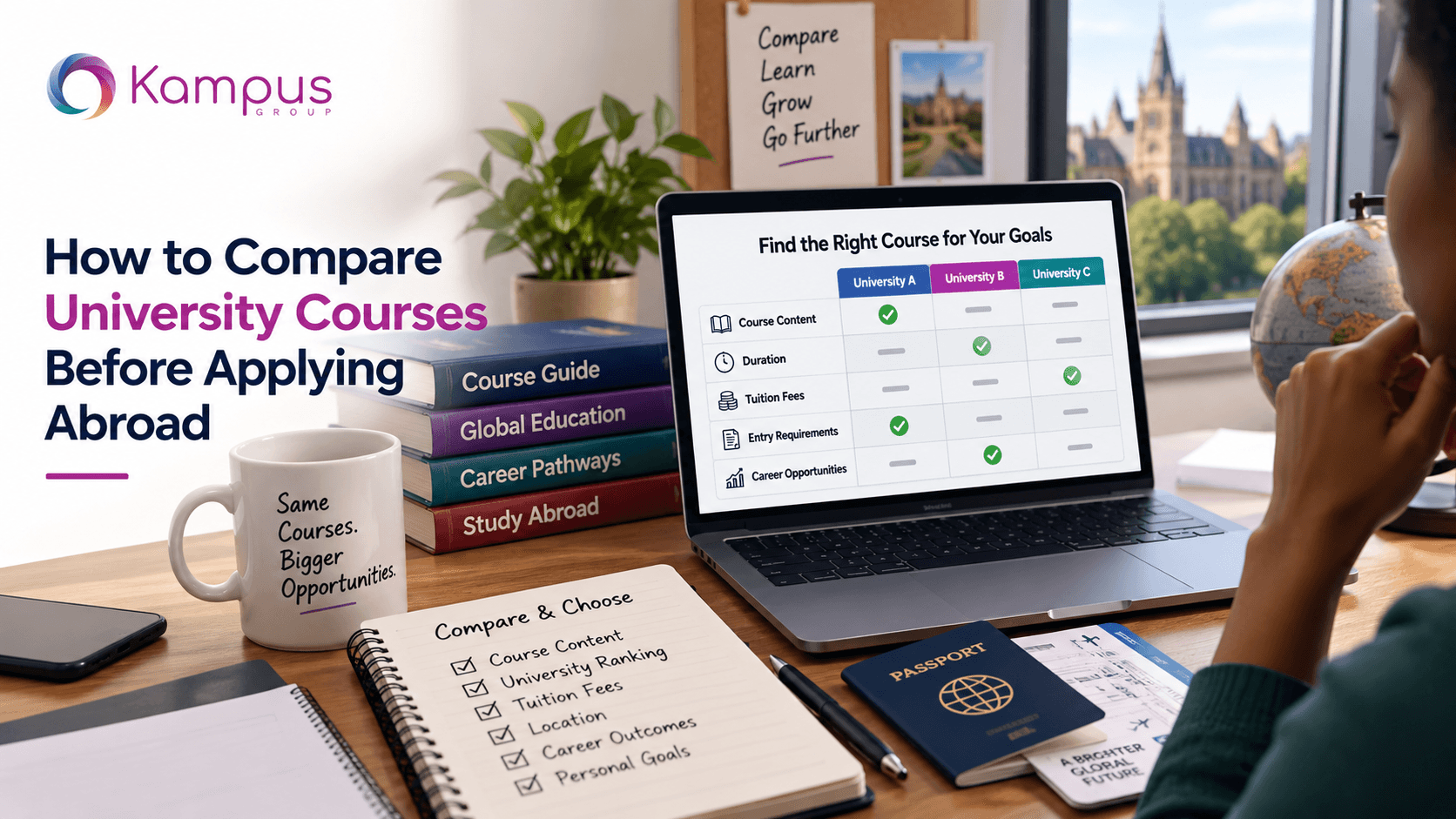
Choosing a university abroad is an exciting decision, but choosing the right course is often even more important.
Two universities may offer degrees with almost identical names while providing completely different academic experiences.
For example, one university’s Computer Science program may focus heavily on artificial intelligence and machine learning, while another may emphasize software engineering, cybersecurity, or theoretical computer science.
The same difference exists across engineering, business, medicine, agriculture, environmental science, architecture, and almost every other discipline.
This is why international students should avoid choosing a university based solely on its ranking, location, or reputation.
Before applying, you need to compare the actual course.
The right course should match your academic interests, career goals, budget, preferred learning style, and plans after graduation.
Why Comparing Courses Matters
A university’s reputation does not tell you everything about what you will experience as a student.
The course determines much of what you will actually study.
It influences:
- The subjects you take
- The skills you develop
- Your workload
- Your assessment methods
- Your practical experience
- Your internship opportunities
- Your specialization options
- Your preparation for employment or postgraduate study
A highly ranked university can still offer a poor fit if its curriculum does not match your goals.
On the other hand, a less famous university may offer a course that aligns much more closely with what you want to achieve.
The goal is not simply to find the best university.
It is to find the best course for you.
1. Start With Your Career Goal
Before comparing universities, identify what you want your degree to help you achieve.
You do not need to know your exact job title.
However, you should have a general direction.
For example:
- Artificial intelligence
- Renewable energy
- Biomedical engineering
- Agribusiness
- Finance
- International business
- Sustainable manufacturing
- Software development
- Marine science
- Urban planning
Then ask:
Does this course actually prepare students for that field?
If you want to become a renewable-energy engineer, a general engineering degree may be useful, but a program with energy systems, power engineering, sustainability, and renewable-energy modules could be a better fit.
2. Compare the Course Curriculum
This is one of the most important steps.
Do not stop at the degree title.
Open the university’s official course page and examine the curriculum.
Look at:
- Required modules
- Optional modules
- Specializations
- Electives
- Laboratory work
- Projects
- Research components
- Final-year dissertation
- Capstone projects
For example, two universities may both offer a degree in Environmental Science.
University A may focus heavily on:
- Climate science
- Ecology
- Conservation
- Fieldwork
University B may focus more on:
- Environmental engineering
- GIS
- Data analysis
- Environmental policy
Neither is automatically better.
The better choice depends on what you want to do after graduation.
3. Look Beyond the Course Name
University course names can sometimes be misleading.
A degree called:
“Business Management”
could contain significant amounts of finance, marketing, entrepreneurship, analytics, or international business.
Likewise:
“Engineering”
could mean a broad first-year program followed by a specialization, while another university may require students to choose a specific engineering discipline immediately.
Read the actual module descriptions.
Ask yourself:
Would I enjoy studying these subjects for three or four years?
4. Compare the Course Length
Degree length varies by country.
For example, undergraduate degrees may commonly take:
- Three years in some countries
- Four years in others
- Four or five years for certain professional programs
Some degrees also include:
- Foundation years
- Placement years
- Co-op terms
- Study abroad semesters
- Integrated master’s programs
Don’t compare tuition without considering the total duration.
A degree with lower annual tuition may not necessarily be cheaper overall if it takes longer to complete.
5. Compare Tuition Fees
International students often pay different tuition rates from domestic students.
Record the annual international tuition for every course you are considering.
Then calculate the approximate total.
For example:
Annual tuition × number of years = estimated tuition cost
But don’t stop there.
Some programs have additional expenses for:
- Laboratory equipment
- Field trips
- Studio materials
- Software
- Professional examinations
- Clinical training
- Insurance
- Equipment or uniforms
The published tuition figure may not represent the full academic cost.
6. Calculate the Total Cost of Studying
Tuition is only one part of studying abroad.
You should also estimate:
- Accommodation
- Food
- Transportation
- Health insurance
- Visa fees
- Flights
- Books
- Study materials
- Personal expenses
This gives you a more realistic total cost of attendance.
A university with slightly higher tuition in an affordable city could potentially cost less overall than a cheaper university located in an extremely expensive city.
7. Investigate Scholarships
Don’t compare courses without considering funding.
Check whether each university offers:
- Merit scholarships
- International student scholarships
- Need-based funding
- Departmental awards
- Research scholarships
- Tuition discounts
- External funding opportunities
Pay attention to eligibility requirements and deadlines.
Some scholarships require you to apply separately, while others automatically consider students after they submit their university application.
8. Check Accreditation
Accreditation can be extremely important.
Some professions have specific educational or professional requirements.
This is particularly relevant to fields such as:
- Engineering
- Medicine
- Nursing
- Architecture
- Pharmacy
- Teaching
- Law
- Accounting
A course may be academically strong but still not provide the professional recognition you need in your intended career or country.
Before applying, find out:
Who accredits the course?
Is the accreditation recognized in the country where I want to work?
Will I need additional qualifications after graduation?
This step can prevent serious problems later.
9. Compare Practical Learning Opportunities
Ask how much practical experience the course provides.
Look for:
- Internships
- Co-op placements
- Laboratory work
- Fieldwork
- Clinical placements
- Industry projects
- Capstone projects
- Research opportunities
- Work-integrated learning
A course that gives students opportunities to apply their knowledge can be particularly valuable for international students.
For example, an engineering course with a six-month industry placement can provide a very different experience from a program that is almost entirely classroom-based.
10. Investigate Research Opportunities
Research opportunities can be important if you plan to pursue a master’s or PhD.
Look for:
- Undergraduate research programs
- Faculty research projects
- Research laboratories
- Summer research opportunities
- Independent research projects
- Student conferences
- Dissertation opportunities
Also investigate the professors.
Are there academics researching subjects that interest you?
A university with strong research activity in your specific area may provide better opportunities than one that simply has a high overall ranking.
11. Compare Teaching Methods
Universities teach differently.
One course may rely heavily on:
- Lectures
- Written examinations
- Essays
Another may emphasize:
- Projects
- Presentations
- Group work
- Laboratory sessions
- Case studies
- Practical assessments
Think about how you learn best.
If you prefer practical problem-solving, a project-based course may suit you better.
If you enjoy academic research and independent reading, a more research-intensive course may be preferable.
12. Compare Assessment Methods
Assessment can have a significant effect on your university experience.
Check whether students are evaluated through:
- Exams
- Coursework
- Presentations
- Group projects
- Laboratory reports
- Research papers
- Portfolios
- Practical assessments
A student who performs poorly under constant examination but excels at project work should consider this when comparing programs.
13. Look at Class Sizes
Class size can affect your learning experience.
Large lecture courses may provide access to extensive resources but offer less direct interaction with professors.
Smaller classes may provide more opportunities for:
- Questions
- Discussion
- Feedback
- Mentoring
- Group interaction
Don’t assume that smaller is always better.
The important question is whether the teaching environment suits you.
14. Research the Professors
The people teaching your course matter.
Visit the university’s department website and look at faculty profiles.
Ask:
- What are their research interests?
- What industries have they worked with?
- Are they active researchers?
- Do they supervise undergraduate students?
- Are their research areas relevant to your interests?
This is particularly important for research-intensive degrees.
15. Compare Industry Connections
A strong relationship between a university and industry can create valuable opportunities.
Look for:
- Corporate partnerships
- Employer-sponsored projects
- Internship networks
- Industry guest speakers
- Career fairs
- Consulting projects
- Employer-led competitions
For professional degrees, industry connections can be almost as important as classroom teaching.
16. Investigate Graduate Outcomes
One of the most important questions to ask is:
What happens to students after graduation?
Look for information about:
- Employment
- Graduate school
- Industries entered
- Employers
- Further study
- Professional qualifications
Graduate-outcome data can help you determine whether the course actually leads toward the career you want.
Be careful with broad university-level statistics.
A university may have excellent overall employment outcomes while a particular course performs very differently.
Where possible, look for course-specific information.
17. Compare Internship and Co-op Opportunities
International students should pay particular attention to practical work opportunities.
A course may advertise internship opportunities, but ask:
Are internships guaranteed?
Are they paid?
How long do they last?
Are international students eligible?
Does the university help students find placements?
Can the placement count toward the degree?
The difference between “students may pursue internships” and “students complete a structured six-month co-op” can be significant.
18. Consider the Location
The university’s location can affect your education and career opportunities.
Ask:
- Is it in a major industry hub?
- Are there companies nearby?
- Is public transportation good?
- Is accommodation affordable?
- Is the city suitable for students?
- Are there internship opportunities nearby?
For example, a student interested in finance may benefit from being near a major financial center.
A student interested in technology may prefer a city with a strong technology ecosystem.
An environmental-science student may value access to natural environments and research sites.
19. Compare Student Support Services
International students may need more support than domestic students.
Look for:
- International student offices
- Academic advising
- Career services
- Mental-health and wellbeing services
- Disability support
- Writing centers
- Language support
- Accommodation assistance
- Visa guidance
A strong support system can make the transition to a new country significantly easier.
20. Check the Language of Instruction
Don’t assume that a university in an English-speaking country is the only place where you can study in English.
Many universities in Europe and Asia offer English-taught programs.
However, verify:
- Whether the entire degree is taught in English
- Whether specific modules are taught in another language
- Whether internships require local-language skills
- Whether clinical or professional placements require local language proficiency
This is particularly important if you plan to work in the country after graduation.
21. Compare International Student Diversity
A diverse student population can enrich the university experience.
You may have opportunities to:
- Meet students from different countries
- Build international friendships
- Work in multicultural teams
- Develop cross-cultural communication
- Build a global professional network
However, don’t judge diversity solely by the percentage of international students.
Look at where those students come from and whether the university actively supports international integration.
22. Look at Campus Facilities
Depending on your course, facilities can make a major difference.
Check for:
- Laboratories
- Libraries
- Engineering workshops
- Research centers
- Computer facilities
- Design studios
- Clinical facilities
- Maker spaces
- Innovation hubs
A materials-science student may need advanced laboratories.
An architecture student may need well-equipped studios.
A computer-science student may prioritize computing facilities and AI research centers.
Match the facilities to your field.
23. Compare University Rankings Carefully
Rankings can be useful, but they should not make the decision for you.
Instead of looking only at overall university rankings, investigate:
- Subject rankings
- Employer reputation
- Research strength
- Course-specific reputation
- Graduate outcomes
A university ranked lower overall could be exceptionally strong in your particular subject.
Subject strength often matters more than overall ranking.
24. Check the University’s Reputation in Your Field
Ask:
Is this university actually respected in the industry I want to enter?
For example, a university may have a strong overall reputation but limited recognition in your particular field.
Talk to:
- Alumni
- Current students
- Industry professionals
- Professors
- Career advisers
Their perspectives can help you understand how the course is perceived beyond the university’s marketing materials.
25. Review the Course’s Flexibility
Your interests may change.
Look for courses that allow you to:
- Change specializations
- Take electives
- Add minors
- Study another subject
- Complete internships
- Study abroad
- Conduct research
Flexibility can be particularly valuable if you are entering university without a fully defined career path.
26. Check Entry Requirements
Compare the academic requirements for every course.
These may include:
- Required grades
- Specific subjects
- Mathematics requirements
- Science prerequisites
- English-language scores
- Entrance examinations
- Portfolios
- Interviews
Don’t assume that all universities use the same requirements for the same degree.
27. Compare English-Language Requirements
International students may need to demonstrate English proficiency through tests such as:
- IELTS
- TOEFL
- PTE
- Other accepted examinations
Requirements can vary by university and course.
Some programs may require higher scores than the university’s general minimum.
Check the requirements for the specific course.
28. Understand Post-Graduation Opportunities
If you plan to work after graduation, investigate what opportunities exist in your chosen destination.
Look at:
- Graduate work options
- Relevant industries
- Professional licensing
- Employer demand
- Immigration pathways
- Alumni employment
Immigration policies can change, so always verify current rules through official government sources before making a decision.
29. Talk to Current Students
University websites are useful, but they naturally present the institution from a positive perspective.
Current students can tell you what the course is actually like.
Ask them:
- How difficult is the workload?
- How accessible are professors?
- Are internships easy to find?
- How much practical work is there?
- What are the biggest challenges?
- What do students wish they had known before applying?
You can find students through university societies, alumni networks, professional communities, and social platforms.
30. Create a University Comparison Table
Once you have researched several courses, put everything into one comparison table.
For example:
| Factor | University A | University B | University C |
|---|---|---|---|
| Course length | 4 years | 3 years | 4 years |
| Annual tuition | $$$ | $$ | $$$ |
| Scholarships | Strong | Moderate | Strong |
| Practical learning | Excellent | Good | Excellent |
| Internship | Yes | Optional | Yes |
| Research | Excellent | Good | Excellent |
| Accreditation | Yes | Yes | Yes |
| Location | Major city | Smaller city | Major city |
| Graduate outcomes | Strong | Strong | Excellent |
| Your course fit | Excellent | Good | Very Good |
This makes it easier to compare options objectively.
A Simple Scoring System
You can also give each university a score from 1 to 5.
For example:
- Course fit — 25%
- Career outcomes — 20%
- Cost — 15%
- Practical experience — 15%
- University reputation — 10%
- Location — 5%
- Scholarships — 5%
- Student support — 5%
Then calculate a weighted score.
This prevents one impressive feature—such as a famous university name—from dominating your entire decision.
Red Flags to Watch For
Be careful if a university or course:
- Provides little information about the curriculum
- Makes vague employment claims
- Does not clearly state tuition fees
- Has unclear accreditation
- Promises guaranteed employment
- Provides limited information about internships
- Uses outdated information
- Has unclear international-student requirements
- Makes unrealistic salary promises
If something sounds too good to be true, investigate it further.
A Step-by-Step Course Comparison Process
If you are overwhelmed by the number of choices, use this process.
Step 1: Choose Your Field
Identify the subject or career area you want to pursue.
Step 2: Find 10–15 Courses
Create a broad initial list.
Step 3: Compare Entry Requirements
Remove courses where you clearly do not meet the requirements.
Step 4: Compare Curriculum
Read the modules carefully.
Step 5: Compare Costs
Calculate tuition plus estimated living expenses.
Step 6: Check Scholarships
Identify funding opportunities and deadlines.
Step 7: Compare Practical Experience
Look for internships, co-op, research, laboratories, and projects.
Step 8: Investigate Career Outcomes
Find out where graduates go after completing the course.
Step 9: Research Location and Lifestyle
Consider housing, transport, safety, and quality of life.
Step 10: Build Your Final Shortlist
Aim for a balanced list of ambitious, target, and safer options.
Questions to Ask Before You Apply
Before submitting an application, you should be able to answer:
What exactly will I study?
How much will the entire degree cost?
What practical experience will I receive?
What careers does this course prepare me for?
Is the qualification accredited?
Can international students access internships and research opportunities?
What scholarships can I apply for?
Where do graduates typically work or continue their education?
Does the location support my career goals?
If you cannot answer these questions, you probably need to research the course further.
Frequently Asked Questions
How do I compare university courses abroad?
Start by comparing the curriculum, entry requirements, tuition, total cost, accreditation, practical learning, research opportunities, graduate outcomes, location, student support, and career opportunities.
Should I choose the university with the highest ranking?
Not necessarily. Rankings are useful for comparison, but course content, subject strength, practical experience, affordability, and career outcomes may be more important for your individual goals.
How important is the course curriculum?
It is extremely important. The curriculum determines many of the subjects, skills, projects, and specializations you will encounter during your degree.
Should I compare tuition fees or total costs?
Compare total costs. Tuition is only one part of the financial commitment. Accommodation, food, transportation, insurance, travel, and course-related expenses can significantly affect your budget.
Why is accreditation important?
Accreditation can confirm that a course meets recognized academic or professional standards. It can be particularly important for regulated professions such as engineering, medicine, nursing, architecture, and pharmacy.
Should international students prioritize internships?
Practical experience can be highly valuable because it helps students apply academic knowledge, develop workplace skills, build professional networks, and improve their CVs.
How can I find out whether a university has good graduate outcomes?
Check the university’s official graduate-outcome information, course pages, government or regulatory data where available, and independent higher-education resources. Course-specific information is preferable to university-wide statistics.
How many universities should I apply to?
There is no universal number. A balanced application strategy can include ambitious, target, and safer options based on your academic profile, budget, and admission requirements.
Should I talk to current students before applying?
Yes. Current students can provide practical information about workload, teaching quality, internships, accommodation, student support, and the overall experience that may not appear on the official course page.
Can I change my course after starting university?
Sometimes. Policies vary by university and country. Some institutions allow students to transfer programs or change majors, while others have strict requirements. Check the university’s policies before applying if flexibility is important to you.

Written by
Fimijoba Micheal Oladokun is an International Student Consultant, SEO Specialist and Technical Writer at Kampus Group Nigeria. He leverages data-driven insights to support strategic decision-making while guiding prospective international students through admissions and study abroad processes. He also creates clear, SEO-optimized technical content that enhances digital engagement and simplifies complex educational topics.
Get a free, unbiased assessment from a Kampus Group advisor — no obligation, completely free.
More on Preparation

Second Master’s in the UK: Eligibility, Requirements and How to Apply
Completing a master’s degree does not mean your academic journey has to end. For international students who want to specialise in a new field, change career direction or gain advanced knowledge, pursuing a second master’
16 Oct 2026
UK Master’s: One-Year Degree vs Longer Postgraduate Programmes
Choosing a postgraduate programme in the United Kingdom involves more than selecting a university or course. One of the most important decisions is whether to complete a traditional one-year master’s degree or choose a l
15 Oct 2026
Best Countries to Study Artificial Intelligence for International Students in 2027
Artificial Intelligence (AI) is transforming industries such as healthcare, finance, manufacturing, education, cybersecurity and transportation. As organisations increasingly use intelligent systems to solve problems and
15 Oct 2026