How to Read a University Course Description Before Applying
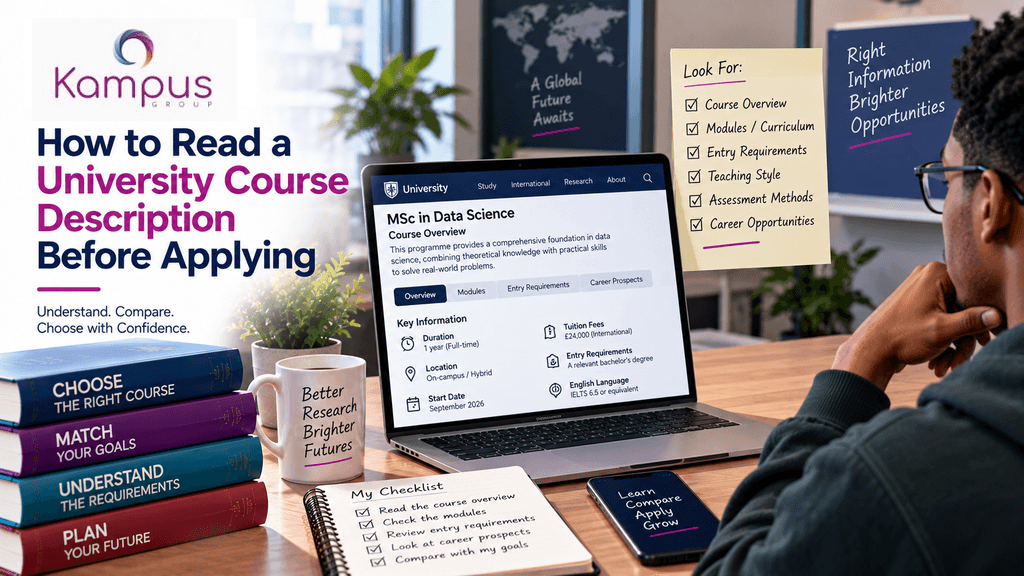
Choosing a university course is one of the most important decisions you will make when planning to study abroad.
However, many students make the mistake of choosing a programme based primarily on its title, university ranking, location, or reputation.
A course title can tell you what a programme is called, but it does not tell you exactly what you will study.
That information is usually found in the course description.
A university course description can reveal important details about the curriculum, teaching methods, assessment structure, admission requirements, career opportunities, programme duration, fees, and practical experience.
Learning how to read this information carefully can help you avoid choosing a programme that looks suitable on the surface but does not actually match your academic interests or career goals.
What Is a University Course Description?
A university course description is an overview of a degree programme provided by the institution.
Depending on the university, it may include:
- Programme overview
- Course structure
- Modules
- Learning outcomes
- Entry requirements
- Assessment methods
- Programme duration
- Tuition fees
- Career opportunities
- Work placements
- Research opportunities
- Accreditation
- Application deadlines
Some universities provide all of this information on one page, while others divide it across several pages.
Your job as an applicant is to connect the information across these pages before deciding whether the programme is right for you.
1. Start With the Programme Overview
The introduction usually explains what the degree is designed to teach.
Do not simply read the first paragraph and move on.
Look for statements explaining:
- The purpose of the degree
- The main academic discipline
- Key areas of specialisation
- Skills students are expected to develop
- The type of career the programme supports
For example, a programme might describe itself as combining computer science with business.
That could mean students study both programming and management, but you need to examine the actual modules to determine how much emphasis is placed on each area.
Ask Yourself:
Does the programme’s overall purpose match what I want to learn?
If the answer is no, there is little reason to continue with the application.
2. Examine the Course Modules
The module list is one of the most important sections of a course description.
Modules show you what you will actually study.
Look at:
- Core modules
- Optional modules
- Electives
- Specialisation tracks
- Final-year projects
- Dissertation requirements
- Practical modules
For example, two degrees might both be called MSc Data Science, but one may focus heavily on machine learning while another concentrates on business analytics.
The title is similar.
The education you receive could be very different.
Core vs. Optional Modules
Core Modules
These are compulsory subjects that every student normally takes.
They tell you what the university considers essential to the degree.
Optional Modules
These allow you to customise your studies.
A programme with a wide range of relevant electives can be useful if you already have a particular career direction.
3. Check the Course Structure
Do not only look at individual modules.
Understand how the entire programme is organised.
For example:
Semester 1 → Core modules
Semester 2 → Advanced modules + electives
Semester 3 → Internship/dissertation/project
This can tell you how quickly the programme moves from foundational concepts to specialised or practical learning.
For undergraduate degrees, also check how the programme develops from first year to final year.
You want to understand the progression of your education.
4. Look for Practical Learning
A good course description should tell you how you will apply what you learn.
Look for terms such as:
- Internship
- Placement
- Laboratory
- Fieldwork
- Industry project
- Capstone project
- Practicum
- Studio work
- Clinical training
- Work-integrated learning
- Research project
Practical experience can be particularly valuable for international students because it can help connect academic knowledge with professional expectations.
However, pay attention to the wording.
There is a major difference between:
“Students may have opportunities to undertake an internship.”
and:
“The programme includes a compulsory six-month industry placement.”
The first suggests an opportunity.
The second describes a defined programme component.
5. Understand the Learning Outcomes
Learning outcomes explain what students should be able to do by the end of the programme.
These may include:
- Analyse complex problems
- Conduct research
- Design technical solutions
- Apply theoretical knowledge
- Use industry-standard tools
- Communicate professionally
- Work in teams
- Evaluate evidence
- Develop practical solutions
Learning outcomes are useful because they allow you to compare the skills taught by different universities.
Ask:
Will these learning outcomes help me qualify for the jobs I want?
6. Check How You Will Be Assessed
A course description may explain how your performance will be evaluated.
Assessment can include:
- Examinations
- Essays
- Presentations
- Group projects
- Laboratory reports
- Portfolios
- Research projects
- Case studies
- Practical demonstrations
- Dissertation
This matters because different students perform better under different assessment styles.
A programme heavily based on examinations will feel very different from one based on projects and continuous assessment.
Why This Matters
If you prefer practical work, a programme dominated by written examinations may not be your ideal choice.
If you are preparing for academic research, a programme with substantial research and dissertation work may be more suitable.
7. Read the Entry Requirements Carefully
Never assume that having a bachelor’s degree automatically qualifies you for a master’s programme.
Universities may require:
- Specific subjects
- Minimum grades
- Relevant undergraduate degrees
- Work experience
- Mathematics
- Laboratory experience
- Portfolio
- Professional qualifications
- English-language proficiency
For undergraduate programmes, requirements may include specific secondary-school subjects or equivalent qualifications.
Pay Attention to “Required” vs. “Preferred”
These words matter.
Required
You generally must meet the requirement.
Preferred
The university considers the qualification desirable, but it may not always be mandatory.
If you are unsure, contact the university before applying.
8. Check International Qualification Requirements
Universities often list entry requirements for domestic applicants and international applicants separately.
As an international student, look for:
- International qualification equivalents
- Country-specific requirements
- Accepted examination systems
- English-language requirements
- Document requirements
- Credential verification
Do not assume that your local qualification will automatically be evaluated in the same way as a domestic qualification.
9. Examine the English-Language Requirements
If the course is taught in English, the university may require evidence of English proficiency.
Look for:
- IELTS requirements
- TOEFL requirements
- PTE requirements
- Cambridge English requirements
- Minimum overall score
- Minimum component scores
- Exemptions
For example, a programme may require:
IELTS 6.5 overall, with no component below 6.0.
Achieving the overall score alone may not be enough.
Always read the complete requirement.
10. Check the Programme Duration
Programme length can vary significantly.
You may find:
- Three-year bachelor’s degrees
- Four-year bachelor’s degrees
- One-year master’s degrees
- Two-year master’s degrees
- Part-time programmes
- Accelerated programmes
Do not assume a shorter programme is automatically better.
A longer programme may include:
- Internship
- Placement
- Research
- Additional specialisation
- Professional training
Compare the value of the curriculum, not just the number of months.
11. Understand the Tuition Fees
Look for the exact tuition fee applicable to international students.
Check whether the amount is:
- Per year
- Per semester
- Per credit
- For the entire programme
Also check whether fees may change in later years.
Your total education budget should include more than tuition.
Consider:
- Accommodation
- Food
- Transportation
- Health insurance
- Visa costs
- Flights
- Books
- Equipment
- Student fees
12. Look for Scholarships
Some course pages provide links to scholarships or financial support.
Investigate:
- University scholarships
- Faculty scholarships
- Government funding
- Merit awards
- Research funding
- External scholarships
Check eligibility carefully.
A scholarship available to international students may have different conditions from one available only to domestic students.
13. Read the Career Information
The career section can help you understand how the university positions the degree professionally.
Look for:
- Graduate job titles
- Industries
- Employers
- Professional pathways
- Further study
- Internship opportunities
- Career services
Do not interpret a list of possible careers as a guarantee.
If a university says graduates “can work as” a particular professional, that does not necessarily mean the degree automatically qualifies you for that profession.
14. Check Professional Accreditation
This is especially important in regulated fields.
Examples include:
- Engineering
- Architecture
- Medicine
- Nursing
- Teaching
- Psychology
- Accounting
- Certain technology professions
Look for information about:
- Accreditation bodies
- Professional recognition
- Registration
- Licensing
- Professional exemptions
If you intend to work in another country after graduation, check whether the qualification will be recognised there as well.
15. Identify the Teaching Methods
Course descriptions sometimes explain how teaching takes place.
You may encounter:
- Lectures
- Seminars
- Tutorials
- Workshops
- Laboratories
- Field trips
- Studio sessions
- Online learning
- Team projects
- Independent study
This can give you a better understanding of what your weekly academic experience will look like.
16. Look at the Faculty
Some universities provide profiles of academic staff associated with the programme.
Investigate:
- Academic qualifications
- Research interests
- Industry experience
- Publications
- Current projects
- Professional expertise
This is especially important for research-intensive master’s degrees.
If you have a particular research interest, see whether the university has faculty members working in that area.
17. Check Research Opportunities
Research opportunities can be particularly valuable if you intend to pursue a PhD.
Look for:
- Research projects
- Research assistant opportunities
- Dissertation options
- Research centres
- Laboratories
- Academic conferences
- Faculty-led research
For research-focused programmes, investigate whether students can work directly with academics.
18. Look for Industry Partnerships
A university may mention relationships with companies or professional organisations.
Look for:
- Employer partnerships
- Sponsored projects
- Industry placements
- Guest speakers
- Company visits
- Consulting projects
- Internship networks
These connections can help students understand how classroom knowledge is applied in professional settings.
19. Understand the Location
The course description may tell you where the programme is taught.
Check whether you will study:
- On the main campus
- At another campus
- At a partner institution
- At a specialist facility
- Across multiple locations
Location can affect your accommodation, transportation and access to industry.
A programme located near a major industry hub may offer different networking opportunities from one in a smaller city.
20. Look for Hidden Details in the Small Print
Some of the most important information can appear outside the main course description.
Look for links or sections labelled:
- Important information
- Additional costs
- Programme regulations
- Terms and conditions
- Admission policies
- Professional requirements
- Visa information
- International student information
- Frequently asked questions
Read these sections before making your final decision.
How to Compare Two Course Descriptions
Suppose you are comparing two master’s programmes.
Do not simply write:
University A = Better university
University B = Lower ranking
Instead, create a structured comparison.
| Factor | University A | University B |
|---|---|---|
| Core modules | ||
| Specialisations | ||
| Practical experience | ||
| Internship | ||
| Research | ||
| Accreditation | ||
| Tuition | ||
| Programme length | ||
| Entry requirements | ||
| Career outcomes | ||
| Location | ||
| Scholarships |
This makes it easier to identify which programme actually fits your goals.
Words and Phrases to Pay Attention To
University course descriptions often use specific language.
Understanding it can help you interpret what the university is actually promising.
| Phrase | What It Usually Means |
|---|---|
| “Students may…” | Possible opportunity, not necessarily guaranteed |
| “Students will…” | Expected or defined programme feature |
| “Opportunity to…” | Available possibility |
| “Required” | Mandatory condition |
| “Recommended” | Strongly advised but not necessarily mandatory |
| “Preferred” | Desirable qualification |
| “Subject to availability” | Not guaranteed |
| “Indicative” | May change |
| “Typical career paths” | Examples, not guarantees |
| “Accredited” | Recognised by a relevant accreditation body |
| “Placement opportunity” | Work experience may be available, but check whether it is guaranteed |
| “Research-led” | Teaching incorporates current research |
| “Industry-focused” | Designed with professional applications in mind |
These distinctions can prevent you from misunderstanding marketing language.
Questions to Ask Before Applying
If the course description does not answer your questions, contact the university.
Consider asking:
- Is the programme fully taught in English?
- Which modules are compulsory?
- Which modules are optional?
- Is an internship guaranteed?
- Is work placement part of the curriculum?
- What are the exact international entry requirements?
- What English-language score is required?
- Is the programme professionally accredited?
- What additional costs should I expect?
- What careers do recent graduates enter?
- Can international students access the internship programme?
- Are scholarships available?
- Can I specialise in my preferred area?
- Can I progress to a PhD after graduation?
- Are there opportunities to work with industry?
Getting answers before applying can save you significant time and money.
A Five-Minute Course Description Test
If you want a quick way to evaluate a programme, answer these five questions:
1. What will I study?
Check the modules.
2. What skills will I develop?
Check the learning outcomes.
3. What will I do with the degree?
Check career outcomes and professional pathways.
4. What will it cost?
Check tuition and additional expenses.
5. Can I actually get in?
Check academic, English-language and other entry requirements.
If you cannot answer these five questions after reading the university’s information, you probably need to conduct more research before applying.
Common Mistakes Students Make
Choosing Based on the Course Title
The title does not tell you everything.
Ignoring Optional Modules
Electives can determine whether you can specialise in your preferred area.
Assuming an Internship Is Guaranteed
Read the wording carefully.
Ignoring Assessment Methods
Your academic experience depends heavily on how you are assessed.
Failing to Check Accreditation
This can be particularly serious for regulated professions.
Looking Only at Tuition
Your total cost includes living expenses and other fees.
Ignoring Entry Requirements
A programme may look perfect but still require qualifications you do not have.
Relying on Outdated Course Information
Programme structures, fees and admission requirements can change.
Always verify the latest information before submitting your application.
Final Course Description Checklist
Before applying, confirm:
- I understand what the programme teaches.
- I have reviewed the core modules.
- I have reviewed the optional modules.
- I understand the programme structure.
- I know how students are assessed.
- I understand the learning outcomes.
- I meet the entry requirements.
- I meet the English-language requirements.
- I know the programme duration.
- I know the international tuition fee.
- I have calculated living costs.
- I understand the internship or placement arrangements.
- I have checked accreditation.
- I have researched career outcomes.
- I have checked scholarship opportunities.
- I understand any additional requirements.
- I have verified the latest information with the university.
FAQ
1. What is a university course description?
A university course description is an overview of a degree programme. It normally provides information about the curriculum, modules, admission requirements, programme duration, assessment, fees, career opportunities and other important details.
2. Why should I read a course description before applying?
A course description helps you determine whether a programme matches your academic interests, career goals, qualifications and budget. It can also reveal important requirements that may not be obvious from the programme title.
3. What is the most important part of a university course description?
The curriculum and module list are among the most important sections because they show what you will actually study. However, you should also check entry requirements, practical opportunities, accreditation, fees and career outcomes.
4. How do I know whether a course is right for my career?
Compare the programme’s modules and learning outcomes with the skills and qualifications required for your target career. Also investigate graduate outcomes, professional accreditation and industry connections.
5. What does “optional module” mean?
An optional module is a subject you can choose from a selection offered by the programme. Optional modules can allow you to specialise in areas relevant to your interests or career.
6. Does a university course description guarantee an internship?
Not necessarily. Look carefully at the wording. “Internship available” or “opportunity for an internship” may not mean every student is guaranteed a placement. Confirm the arrangement directly with the university.
7. How can I tell if I meet a university’s entry requirements?
Compare your academic qualifications, grades, subjects, work experience and English-language results with the requirements listed for international applicants. If anything is unclear, contact the admissions office.
8. Why is accreditation important?
Accreditation can confirm that a programme meets standards established by a recognised professional or educational body. It can be particularly important when pursuing regulated careers such as engineering, architecture, healthcare or teaching.
9. Should I choose a course based on its university ranking?
No. Rankings can be useful, but they should not be your only consideration. Curriculum, career outcomes, accreditation, practical experience, cost and programme suitability can be more important for your individual goals.
10. What should I do if I do not understand part of a course description?
Contact the university’s admissions, programme or international student team. Ask specific questions about anything that could affect your eligibility, costs, academic experience or career plans.

Written by
Fimijoba Micheal Oladokun is an International Student Consultant, SEO Specialist and Technical Writer at Kampus Group Nigeria. He leverages data-driven insights to support strategic decision-making while guiding prospective international students through admissions and study abroad processes. He also creates clear, SEO-optimized technical content that enhances digital engagement and simplifies complex educational topics.
Get a free, unbiased assessment from a Kampus Group advisor — no obligation, completely free.
More on Academic Writing

How to Prepare and Pass a UK Credibility Interview
Receiving an offer from a UK university is an important step towards studying abroad, but your university admission does not automatically guarantee a Student visa. Depending on your circumstances, UK Visas and Immigrati
23 Oct 2026
Second Master’s vs MBA: What Is the Difference?
Choosing between a second master’s degree and a Master of Business Administration (MBA) can be challenging, especially if you already hold a postgraduate qualification and want to improve your career prospects. Both qual
23 Oct 2026
UK Master’s: One-Year Degree vs Longer Postgraduate Programmes
Choosing a postgraduate programme in the United Kingdom involves more than selecting a university or course. One of the most important decisions is whether to complete a traditional one-year master’s degree or choose a l
15 Oct 2026