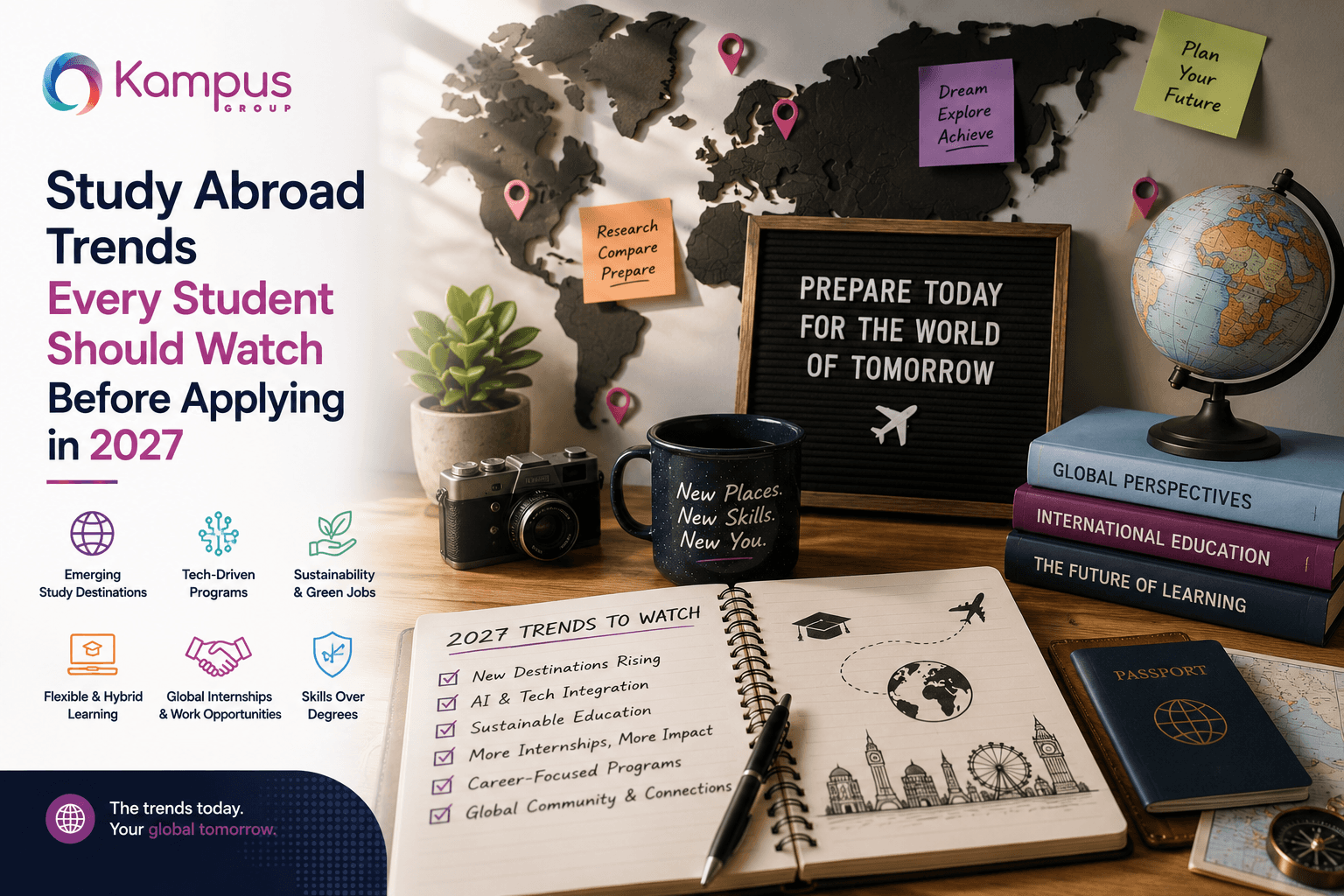
Study Abroad Trends Every Student Should Watch Before Applying in 2027
Studying abroad is becoming a more competitive and more complicated decision.
For years, international students often focused on a familiar group of destinations: the United States, United Kingdom, Canada, and Australia. These countries remain major destinations for international education, but the global study-abroad market is changing.
Students are now comparing more countries, paying closer attention to visa policies, considering affordability and graduate employment, and exploring universities outside the traditional study destinations.
Recent international education data shows that more than three-quarters of prospective international students are now considering multiple destinations before making a decision. At the same time, policy changes in major destinations are influencing where students apply.
For students planning to apply in 2027, understanding these changes could help you make a more informed decision.
Here are the major study abroad trends to watch.
1. Students Are Looking Beyond the Traditional “Big Four”
The United States, United Kingdom, Canada, and Australia remain important destinations for international students.
However, they are no longer the only countries attracting significant interest.
Students are increasingly exploring destinations across mainland Europe and Asia, particularly where universities offer strong academic programs, reasonable costs, English-taught degrees, and clearer pathways after graduation. Recent mobility analysis points to a diversification of student flows away from the traditional major destinations.
Countries gaining attention include:
- Germany
- France
- Ireland
- Netherlands
- Spain
- Italy
- Portugal
- Finland
- Sweden
- Singapore
- Japan
- South Korea
- Malaysia
This does not mean traditional destinations are disappearing.
It means students have more choices than before.
For 2027 applicants, that is important.
Instead of asking:
“Which of the four major destinations should I choose?”
you may want to ask:
“Which country offers the best combination of education, affordability, career opportunities, and immigration stability for my goals?”
2. Visa Policies Are Becoming a Major Part of the Decision
Academic reputation has traditionally been one of the biggest factors influencing where students study.
Visa policy is becoming almost equally important.
The OECD reports that countries including Australia, Canada, the Netherlands, and the UK have introduced tighter international-student policies since 2024, with effects increasingly visible in study-permit and enrolment data.
That means students should no longer leave visa research until after receiving admission.
Before applying, investigate:
- Student visa requirements
- Financial requirements
- Processing times
- Work restrictions
- Dependants’ policies
- Post-study work options
- Graduate immigration pathways
- Recent policy changes
A university can be academically excellent but still be a poor fit if its immigration environment does not align with your plans.
3. Affordability Is Becoming More Important
Tuition is only one part of the cost of studying abroad.
Students are increasingly considering the total cost of:
- Tuition
- Accommodation
- Food
- Transportation
- Health insurance
- Visa fees
- Flights
- Books and equipment
- Currency exchange
- Other living expenses
This is contributing to greater interest in countries and universities that offer stronger value for money.
For 2027 applicants, comparing total study costs rather than tuition alone will become increasingly important.
A university with slightly higher tuition could ultimately be more affordable if living costs are significantly lower or substantial scholarships are available.
4. Employability Is Becoming a Central Consideration
Students increasingly want their education to lead somewhere.
A degree is no longer being evaluated only by its academic reputation.
Students are asking:
What jobs can I get after graduation?
Can I gain work experience while studying?
Can I remain in the country after graduation?
Which industries are hiring graduates from this program?
This is especially important as international students become more value-conscious.
When comparing universities for 2027, investigate:
- Internship opportunities
- Co-op programs
- Career services
- Industry partnerships
- Graduate employment outcomes
- Employer networks
- Post-study work opportunities
A strong university experience should ideally provide both academic knowledge and career preparation.
5. Work-Integrated Learning Will Become Even More Valuable
Students are increasingly looking for opportunities to apply what they learn.
This includes:
- Co-op programs
- Internships
- Research placements
- Clinical experience
- Industry projects
- Entrepreneurship programs
- Fieldwork
- Laboratory experience
Universities with strong work-integrated learning can give students an advantage when entering competitive graduate job markets.
For international students, practical experience can also help demonstrate that they understand how their academic knowledge applies in a professional environment.
When evaluating a program, don’t just ask what courses you will take.
Ask:
“What will I actually get to do?”
6. AI Is Changing What Students Study
Artificial intelligence is affecting almost every academic discipline.
Students are increasingly considering programs connected to:
- Artificial intelligence
- Data science
- Robotics
- Cybersecurity
- Computer science
- Automation
- Digital health
- Financial technology
- AI-enabled business
- Sustainable technology
But the bigger trend is that AI is also becoming relevant outside traditional technology degrees.
Agriculture students may study AI-powered precision farming.
Biomedical students may study AI-assisted medical imaging.
Business students may study AI analytics.
Urban planning students may study smart-city systems.
Manufacturing students may study robotics and automation.
For 2027 applicants, one useful question is:
“How is AI changing this field, and does this program prepare me for that change?”
7. Interdisciplinary Degrees Are Becoming More Attractive
Many emerging careers do not fit neatly into one academic discipline.
Consider:
AI + Healthcare
Business + Data Science
Engineering + Sustainability
Agriculture + Technology
Urban Planning + Data Analytics
Finance + Computer Science
Biology + Engineering
This is helping drive interest in interdisciplinary programs and dual-degree options.
Students are increasingly looking for programs that allow them to combine different skill sets rather than studying subjects in isolation.
The advantage is that graduates can potentially position themselves at the intersection of multiple industries.
8. Research Opportunities Are Becoming a Bigger Differentiator
For students interested in postgraduate study, innovation, or technical careers, research experience can be extremely valuable.
Research-intensive universities can provide access to:
- Laboratories
- Research institutes
- Professors
- Undergraduate research programs
- Research internships
- Conferences
- Publications
- Industry research projects
International students should investigate whether undergraduate students are actually given opportunities to participate in research.
A university can have an impressive research reputation without giving every undergraduate meaningful research access.
9. English-Taught Programs Are Expanding Beyond English-Speaking Countries
One of the biggest advantages of studying in an English-speaking country has traditionally been the availability of English-language programs.
That advantage is becoming less exclusive.
Universities across continental Europe and Asia are expanding their English-taught offerings, helping countries such as Germany, the Netherlands, France, Italy, Sweden, Finland, Japan, and South Korea attract international students. Recent reporting points to substantial growth in English-language provision at universities outside the traditional English-speaking destinations.
This gives students more options.
You may be able to study an internationally relevant degree in English while also gaining exposure to another language and culture.
However, students should still investigate whether the program is fully taught in English and whether local-language skills are needed for internships or employment.
10. Asia Is Becoming an Increasingly Important Study Destination
International education is not only becoming more diverse geographically.
Asia is becoming increasingly important within the global student mobility landscape.
Singapore, Japan, South Korea, Malaysia, and other Asian education hubs are strengthening their international offerings.
QS research projects significant growth in international student mobility toward Asia, particularly through intra-Asian student flows.
For students interested in:
- Technology
- Engineering
- Robotics
- AI
- Business
- Manufacturing
- Biotechnology
Asian destinations can offer strong academic and industry ecosystems.
11. Students Are Comparing Multiple Countries Before Applying
The era of applying to one country and hoping for the best is becoming less practical.
Recent IDP research found that 78% of prospective and current international students surveyed were considering multiple study destinations, up from 66% in October 2024.
This is a sensible strategy.
Instead of building your entire plan around one country, create a balanced shortlist.
For example:
Ambitious options
Universities where admission may be highly competitive.
Target options
Universities where your academic profile aligns well with typical applicants.
Safer options
Universities where you have a stronger probability of admission.
Do the same with countries.
A diversified application strategy can reduce the risk of being affected by changing admissions or visa conditions in one destination.
12. Scholarships and Funding Will Matter More
As the cost of international education rises, funding is becoming an increasingly important part of the decision.
Students should investigate:
- University scholarships
- Government scholarships
- Research funding
- Tuition discounts
- Merit scholarships
- Need-based funding
- Assistantships
- External scholarships
- Paid internships
Do not wait until you receive an admission offer.
Some scholarship deadlines occur before university application deadlines.
For 2027 entry, start researching funding opportunities early.
13. Students Are Paying More Attention to Housing
Accommodation has become an increasingly important part of the international student experience.
A university may be excellent academically, but if housing is extremely expensive or difficult to secure, the total cost of attendance can change dramatically.
Before applying, investigate:
- University housing
- Private rentals
- Average rent
- Housing availability
- Distance from campus
- Public transportation
- Housing application deadlines
This is particularly important in major cities where international student demand has placed significant pressure on accommodation markets.
14. Sustainability Is Influencing University Choices
Students are increasingly interested in how universities and cities approach sustainability.
This can include:
- Renewable energy
- Green buildings
- Sustainable transportation
- Climate research
- Environmental programs
- Sustainable food systems
- Circular economy initiatives
For students studying environmental science, renewable energy, agricultural technology, sustainable manufacturing, or related fields, the surrounding innovation ecosystem can be particularly important.
The best destination may be one where sustainability is not simply a course topic but part of the wider economy and research environment.
15. Digital and Hybrid Education Will Remain Part of the Landscape
Studying abroad does not always mean every learning activity happens inside a classroom.
Universities increasingly use:
- Online learning
- Digital laboratories
- Virtual collaboration
- Hybrid courses
- Online academic resources
- Digital research tools
This can provide additional flexibility.
However, international students should distinguish between a genuinely international campus experience and a program that delivers much of its education remotely.
If your main reason for studying abroad is cultural immersion and professional networking, check how much of the program is actually delivered on campus.
16. Transnational Education Is Creating More Options
Students do not always need to travel abroad for every part of an international degree.
Universities are increasingly developing:
- International branch campuses
- Joint degrees
- Dual degrees
- Franchise arrangements
- International partnerships
- Collaborative programs
These models can allow students to gain international qualifications or experiences without following the traditional four-year “move abroad and stay there” model.
They can also provide alternative pathways for students who face financial, visa, or travel constraints.
17. Student Mobility Is Becoming More Diversified
The global student market is moving away from a model dominated by a small number of countries.
Recent mobility analysis suggests that international student demand is increasingly spreading across a wider range of destinations, particularly across Europe and Asia.
For students, this means competition may increase in some destinations while new opportunities emerge elsewhere.
The most important skill is therefore not memorizing a list of “best countries.”
It is learning how to evaluate destinations strategically.
18. Country Choice Will Depend More on Your Field
There is no universal best country for studying abroad.
The best destination for one subject may be completely different from the best destination for another.
For example:
Robotics
Japan, Germany, South Korea, USA, Switzerland
Agricultural Technology
Netherlands, USA, Australia, Canada, Germany
Renewable Energy
Germany, Denmark, Sweden, Netherlands, Canada
Biomedical Engineering
USA, Germany, UK, Switzerland, Singapore
Artificial Intelligence
USA, UK, Canada, Singapore, South Korea
Sustainable Manufacturing
Germany, Sweden, Netherlands, Japan, Finland
This means students should choose destinations after identifying their academic and career priorities, rather than choosing a country first.
19. Post-Study Opportunities Will Influence Applications
A degree can be valuable, but students also need to think about what happens afterward.
Some countries provide pathways that allow international graduates to remain temporarily for work after completing their studies.
Others have become more restrictive.
Because these rules can change quickly, students applying for 2027 should verify current requirements directly with government and university sources before making a final decision.
Do not rely on a social-media post from two years ago.
20. Students Will Need to Start Planning Earlier
The growing complexity of international education means waiting until the final months before departure is increasingly risky.
You may need time to:
- Research universities
- Prepare standardized tests
- Take English-language tests
- Write application essays
- Request recommendation letters
- Prepare financial documents
- Apply for scholarships
- Submit applications
- Receive admission
- Apply for a visa
- Find accommodation
- Arrange travel
A 2027 applicant should ideally begin serious planning well before the application deadline.
A 2027 Study Abroad Checklist
Before applying, ask yourself:
Academic
- Does the university offer the specialization I want?
- Are the professors and research facilities strong in my field?
- Does the curriculum include practical learning?
Financial
- What is the total cost?
- Are scholarships available?
- Can I realistically afford the full program?
Career
- Are internships available?
- Does the university have strong employer partnerships?
- What do graduates typically do afterward?
Immigration
- What are the current student-visa requirements?
- Can international students work while studying?
- What are the post-study options?
Lifestyle
- Is accommodation affordable?
- Is the city safe and accessible?
- Will I be comfortable living there?
International Experience
- Is the campus genuinely diverse?
- Will I have opportunities to build an international network?
- Are there opportunities to study or work in other countries?
How Students Should Respond to These Trends
The biggest lesson for 2027 applicants is simple:
Do not choose your study destination based on reputation alone.
Instead, evaluate the full picture.
A practical decision framework is:
Academic quality + affordability + visa stability + employability + practical experience + quality of life
The strongest destination is usually the one that performs well across the factors that matter most to you.
Frequently Asked Questions
What are the biggest study abroad trends for 2027?
The major trends include greater destination diversification, increased attention to visa policies, stronger demand for employability and value, growing interest in Europe and Asia, more interdisciplinary programs, and greater emphasis on practical learning and post-study opportunities.
Are students still choosing the USA, UK, Canada, and Australia?
Yes. These remain major international student destinations. However, their share of future growth is being challenged by emerging destinations, particularly in Europe and Asia.
Which countries are becoming popular for international students?
Countries across continental Europe and Asia are attracting growing attention, including Germany, France, Ireland, the Netherlands, Italy, Spain, Portugal, Singapore, Japan, and South Korea.
Should I consider visa policies when choosing a university?
Absolutely. Visa and post-study work policies can directly affect your ability to enter a country, work during or after your studies, and remain there after graduation. Recent research shows that visa policy is increasingly influencing international student mobility.
Will AI affect what I should study abroad?
Yes. AI is transforming many industries, not only technology. Students should consider how AI will affect their chosen field and whether their program provides relevant digital, analytical, and interdisciplinary skills.
When should I start preparing to study abroad in 2027?
Ideally, begin researching at least a year before your intended start date. Earlier preparation gives you more time to compare universities, identify scholarships, complete tests, prepare applications, and understand visa requirements.

Written by
Fimijoba Micheal Oladokun is an International Student Consultant, SEO Specialist and Technical Writer at Kampus Group Nigeria. He leverages data-driven insights to support strategic decision-making while guiding prospective international students through admissions and study abroad processes. He also creates clear, SEO-optimized technical content that enhances digital engagement and simplifies complex educational topics.
Get a free, unbiased assessment from a Kampus Group advisor — no obligation, completely free.
More on Study Abroad

Best Countries to Study International Business and Global Management
International Business and Global Management are popular choices for students who want to build careers in multinational companies, international trade, management consulting, marketing, finance, logistics or entrepreneu
15 Oct 2026
UK Master’s: One-Year Degree vs Longer Postgraduate Programmes
Choosing a postgraduate programme in the United Kingdom involves more than selecting a university or course. One of the most important decisions is whether to complete a traditional one-year master’s degree or choose a l
15 Oct 2026
Best Countries to Study Artificial Intelligence for International Students in 2027
Artificial Intelligence (AI) is transforming industries such as healthcare, finance, manufacturing, education, cybersecurity and transportation. As organisations increasingly use intelligent systems to solve problems and
15 Oct 2026