What Is a Conditional University Offer and What Should You Do Next?
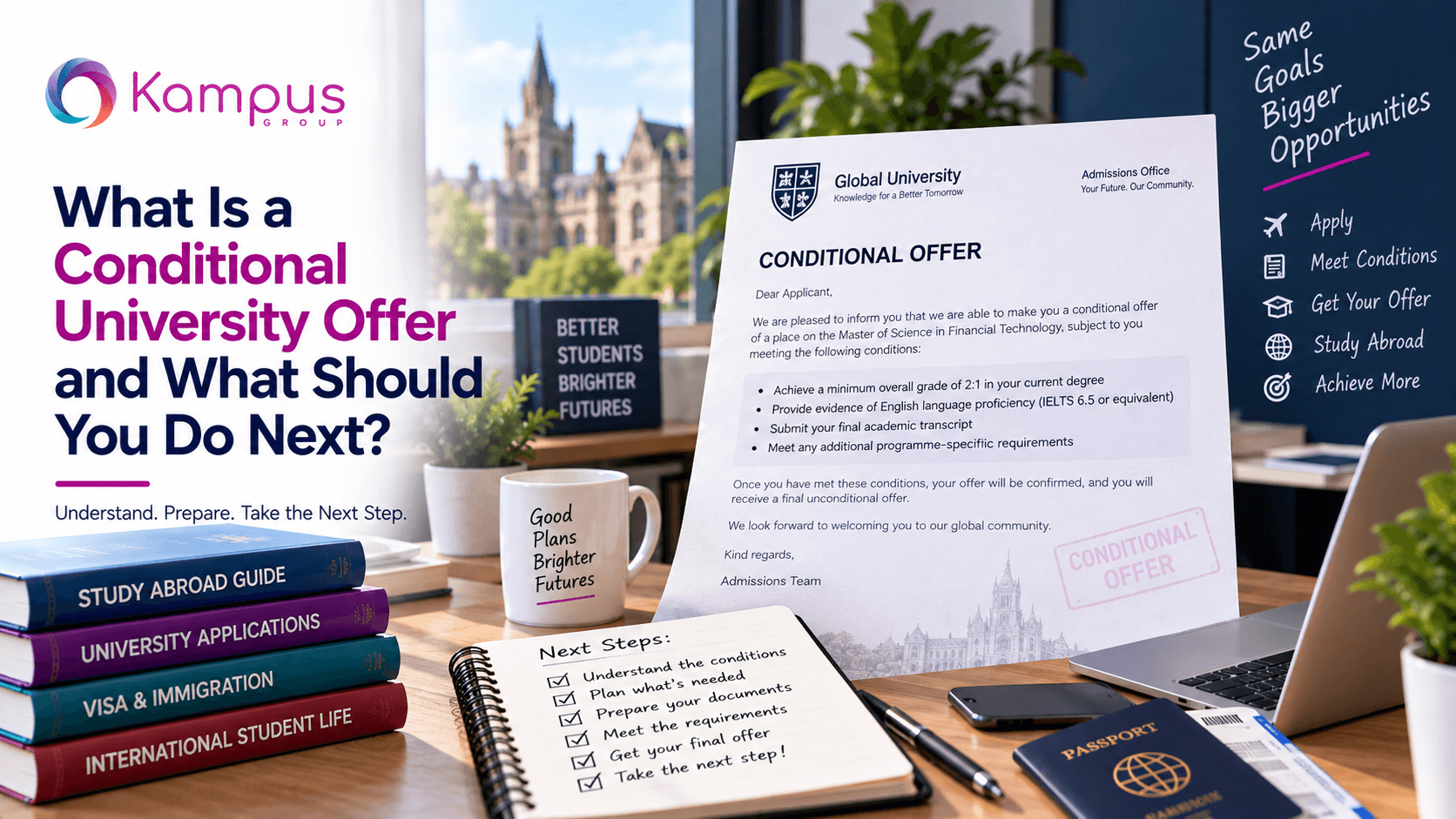
Receiving a university offer is one of the most exciting moments in the study-abroad application process. However, international students may sometimes receive an offer that comes with a few requirements attached.
This is known as a conditional university offer.
A conditional offer does not necessarily mean that your admission is uncertain. Instead, it means the university is willing to offer you a place provided that you meet specific conditions by a stated deadline.
These conditions could involve your final academic results, English-language test, missing documents, financial requirements, or other programme-specific requirements.
Understanding exactly what your offer means is important because failing to meet a condition could affect your ability to enrol.
What Is a Conditional University Offer?
A conditional university offer is an admission offer that requires you to satisfy one or more outstanding requirements before your place at the university becomes fully confirmed.
For example, a university might offer admission to a master’s programme on the condition that you:
- Submit your final bachelor’s degree certificate
- Achieve a specified final grade
- Provide an acceptable English-language test result
- Submit a missing transcript
- Provide evidence of relevant qualifications
- Complete a required prerequisite
- Meet another programme-specific requirement
The exact conditions will normally be stated in your offer letter or applicant portal.
The important thing to understand is that receiving a conditional offer is generally a positive step: the university has assessed your application and is prepared to admit you if you satisfy the outstanding requirements.
Conditional Offer vs. Unconditional Offer
The difference is straightforward.
| Conditional Offer | Unconditional Offer |
|---|---|
| You must satisfy specific conditions | No outstanding admission conditions |
| Your place depends on meeting requirements | Your admission is confirmed subject to enrolment procedures |
| Conditions are listed in your offer | There are generally no academic conditions remaining |
| You may need to submit additional documents | Most required admission documents have been accepted |
| You need to monitor deadlines carefully | You can generally proceed to the next stage |
For international students, the exact meaning of “unconditional” can vary. An unconditional academic offer does not necessarily mean that you have completed every administrative, financial, immigration, or enrolment requirement.
Always read the university’s instructions carefully.
What Conditions Can Universities Attach to an Offer?
Conditions differ between universities and programmes, but some are particularly common.
1. Final Academic Results
If you applied before completing your current qualification, the university may issue an offer based on your expected results.
For example, an undergraduate student applying for a master’s degree may receive an offer requiring them to successfully complete their bachelor’s degree.
A university could also specify a minimum final grade.
2. English-Language Requirement
International students may need to provide evidence of English proficiency.
The university could require a specific score in a recognised test such as:
- IELTS
- TOEFL
- PTE Academic
- Another accepted English-language assessment
The required score can vary by university and programme.
Some universities may waive the requirement if you meet particular criteria.
3. Academic Documents
Your application may be missing documents such as:
- Final transcript
- Degree certificate
- Graduation certificate
- Official academic records
- Certified copies
- Academic references
The offer may remain conditional until these documents are submitted and verified.
4. Qualification Verification
International universities may need to verify qualifications earned in another country.
This can involve document verification, credential assessment, or other procedures depending on the institution.
5. Prerequisite Courses
Some programmes require students to have completed particular subjects before admission.
For example, a master’s programme in data science might require previous study in mathematics or statistics.
If you have not completed the prerequisite, the university may specify another way of satisfying the requirement.
6. Professional Requirements
Certain programmes may require evidence of professional experience, registration, a portfolio, interviews, or other qualifications.
This is more common in specialised or professionally oriented programmes.
7. Financial or Administrative Requirements
In some cases, additional requirements may apply before enrolment or the issuance of documents needed for immigration procedures.
Students should distinguish these requirements from academic admission conditions.
Where Can You Find Your Conditions?
Your conditions should normally appear in one or more official university communications.
Check:
- Your offer letter
- Applicant portal
- University email
- Admissions correspondence
- Programme webpage
- International student instructions
Read the wording carefully.
For example:
“Obtain a minimum overall IELTS score of 6.5 with no component below 6.0.”
is very different from:
“Provide evidence of English-language proficiency.”
The first gives you a specific target. The second may require you to contact the university to determine exactly what evidence is acceptable.
If something is unclear, ask the university rather than guessing.
What Should You Do After Receiving a Conditional Offer?
Receiving the offer is not the end of the process.
Use the following steps to manage it properly.
Step 1: Read the Entire Offer Letter
Do not focus only on the programme name and tuition fee.
Read all sections of the offer.
Identify:
- Conditions
- Deadlines
- Tuition information
- Deposit requirements
- Documents required
- Acceptance instructions
- Deferral rules
- Withdrawal conditions
- Other important terms
Save a copy of the offer letter.
Step 2: Make a List of Every Outstanding Condition
Create a simple checklist.
| Condition | Deadline | Status |
|---|---|---|
| Final transcript | Date | Pending |
| English test | Date | Booked |
| Degree certificate | Date | Pending |
| Deposit | Date | Pending |
| Other requirement | Date | Pending |
This makes the process easier to manage.
Step 3: Prioritise Time-Sensitive Requirements
Some requirements take longer than others.
For example, if you need an English-language test, you may need time to:
- Book the examination
- Prepare
- Take the test
- Receive the result
- Send the result to the university
Start early rather than waiting until the deadline approaches.
Step 4: Check Whether You Need to Accept the Offer
Some universities require students to formally accept an offer by a specific date.
Others may provide different instructions.
Follow the instructions in your offer letter.
If accepting the offer requires a deposit, make sure you understand the deposit’s refund conditions before paying.
Step 5: Submit Documents Correctly
Check whether documents must be:
- Uploaded online
- Sent by email
- Sent directly by your previous institution
- Certified
- Translated
- Submitted through a third-party verification service
Submitting the correct document in the wrong format may delay the process.
What If Your Condition Is an English-Language Test?
This is one of the most common concerns for international students.
If your offer requires an English-language test, first identify:
- Accepted test
- Minimum overall score
- Minimum score in each section
- Test validity period
- Submission deadline
- Whether online versions are accepted
- Whether alternative tests are accepted
Do not assume that achieving the overall score is enough.
For example, a university could require:
Overall: 6.5
Minimum in each component: 6.0
A student who achieves an overall 7.0 but scores 5.5 in one component may still fail to meet the condition.
Always check the exact requirements.
What If You Are Waiting for Your Final Academic Results?
If your offer depends on your final results, focus on completing your current qualification successfully.
Keep track of:
- Expected results date
- University deadline
- Required grade
- Official transcript availability
- Degree certificate availability
Once your results are available, submit the required evidence as quickly as possible.
Do not assume that the university will automatically receive your results unless it has specifically told you so.
What If You Cannot Meet the Conditions?
This is where you should act quickly.
If you believe you will not meet one of your conditions, contact the university’s admissions team.
Explain:
- Which condition you are concerned about
- Why you may not meet it
- What evidence you currently have
- Whether you expect to satisfy it later
- Whether an alternative is available
Depending on the circumstances, the university may:
- Allow additional time
- Accept an alternative qualification
- Reassess your application
- Offer a different programme
- Withdraw the offer
There is no universal outcome, so communication is important.
Can You Accept a Conditional Offer?
Usually, yes, if the university’s instructions allow it.
Accepting the offer does not necessarily mean that you have already satisfied the conditions.
You may still need to complete the outstanding requirements before your admission is finalised.
Check whether acceptance requires a deposit or other payment.
Should You Pay a Deposit on a Conditional Offer?
It depends on the university’s terms.
Some institutions require a deposit to confirm your place even while certain conditions remain outstanding.
Before paying, check:
- Whether the deposit is refundable
- Whether it counts toward tuition
- What happens if you fail to meet a condition
- What happens if your visa is refused
- The payment deadline
- The refund deadline
- Whether the deposit can be transferred
If the policy is unclear, ask the university in writing.
What Happens After You Meet the Conditions?
Once you have satisfied the university’s requirements, the institution may update your offer to unconditional or otherwise confirm that you have fulfilled the conditions.
You may then be able to proceed with the next stages, such as:
- Final enrolment
- Tuition arrangements
- Accommodation
- Student visa application
- Pre-arrival registration
- Orientation
- Travel planning
The exact sequence varies by country and university.
Conditional Offers and Student Visas
International students should pay particular attention to the relationship between admission conditions and immigration requirements.
In some destinations, universities issue specific documentation needed for a student visa only after certain admission and financial requirements have been completed.
For example, the university may require you to satisfy academic conditions and complete specified financial steps before issuing the relevant immigration document.
Do not assume that receiving a conditional offer means you can immediately begin every part of your visa process.
Check the university’s instructions and the official immigration requirements for your destination country.
What If Your Offer Has a Deadline?
Never ignore an offer deadline.
Your offer could specify dates for:
- Accepting the offer
- Meeting academic conditions
- Submitting documents
- Paying a deposit
- Providing test results
- Completing enrolment
Put every deadline into your calendar.
If you cannot meet a deadline, contact the university before it expires.
Can a Conditional Offer Expire?
Yes.
Universities can set deadlines by which applicants must accept an offer or satisfy conditions.
If you miss a deadline without contacting the university, the offer may lapse.
This is why international students should treat every date in the offer letter as important.
What If You Receive Conditional Offers From Multiple Universities?
This is a common situation.
You may receive offers from several universities, each with different conditions.
Create a comparison table:
| University | Programme | Conditions | Deposit | Deadline | Preferred Choice |
|---|---|---|---|---|---|
| University A | Programme | English test | Required | Date | Yes |
| University B | Programme | Final grade | Required | Date | Maybe |
| University C | Programme | Documents | None | Date | Backup |
This allows you to compare your options rationally.
Do not choose a university solely because it sends an offer first.
Consider:
- Programme quality
- Career outcomes
- Cost
- Scholarships
- Location
- Industry opportunities
- Accommodation
- Visa considerations
- Post-graduation plans
Common Mistakes to Avoid
Ignoring the Conditions
Receiving an offer does not mean every admission requirement has been completed.
Missing Deadlines
A missed deadline can create unnecessary problems.
Assuming the University Will Contact You
You are responsible for monitoring your application unless the university specifically tells you otherwise.
Sending the Wrong Documents
Check exactly what the university requires and how it must be submitted.
Waiting Until the Last Minute
Tests, document verification and official transcripts can take time.
Paying a Deposit Without Reading the Refund Policy
Understand your financial commitment before making a payment.
Assuming a Visa Is Guaranteed
An admission offer does not guarantee a student visa.
Visa decisions are made according to the applicable immigration rules and procedures.
A Conditional Offer Checklist for International Students
Before moving to the next stage, make sure you have:
- Read the complete offer letter
- Identified every condition
- Recorded all deadlines
- Checked the required academic grades
- Confirmed English-language requirements
- Identified missing documents
- Checked document-format requirements
- Confirmed how to accept the offer
- Reviewed any deposit requirement
- Read the deposit refund policy
- Checked relevant visa requirements
- Submitted completed conditions
- Saved evidence of every submission
- Confirmed receipt where necessary
FAQ
1. What does a conditional university offer mean?
A conditional university offer means the university is offering you admission provided that you satisfy specific requirements. These may include final grades, English-language results, documents, prerequisites, or other programme conditions.
2. Is a conditional offer a good sign?
Yes. It generally means the university is prepared to admit you, subject to the conditions listed in your offer. You must still satisfy those requirements before your admission is fully confirmed.
3. Can I accept a conditional university offer?
Usually, yes, provided the university’s instructions allow you to accept it. Check the offer letter carefully because accepting the offer may involve a deadline or deposit.
4. What happens if I do not meet my conditional offer?
The outcome depends on the university and the specific condition. The university may give you additional options, reassess your application, offer an alternative programme, or withdraw the offer.
5. Can I pay a deposit after receiving a conditional offer?
Some universities require deposits from students with conditional offers, while others may not. Before paying, check the university’s deposit and refund policy, especially what happens if you fail to meet an outstanding condition.
6. What are common conditions attached to university offers?
Common conditions include achieving a required final grade, completing a bachelor’s degree, submitting official documents, meeting English-language requirements, completing prerequisite courses, or satisfying programme-specific requirements.
7. Can I get a visa with a conditional university offer?
This depends on the destination country and the specific immigration process. Some visa processes require students to have completed particular university conditions before the necessary documentation can be issued. Always check current official immigration requirements.
8. What should I do if I cannot meet my offer deadline?
Contact the university as soon as possible, preferably before the deadline. Explain your situation and ask whether an extension or alternative arrangement is available.
9. How do I know when I have met all my conditions?
The university should normally confirm that you have satisfied the outstanding requirements. Check your applicant portal and university communications, and contact admissions if your status does not update.
10. What is the difference between a conditional and unconditional offer?
A conditional offer requires you to satisfy specified requirements before admission is fully confirmed. An unconditional offer generally means that the university has accepted your academic admission requirements without outstanding conditions, although other enrolment or immigration requirements may still apply.

Written by
Fimijoba Micheal Oladokun is an International Student Consultant, SEO Specialist and Technical Writer at Kampus Group Nigeria. He leverages data-driven insights to support strategic decision-making while guiding prospective international students through admissions and study abroad processes. He also creates clear, SEO-optimized technical content that enhances digital engagement and simplifies complex educational topics.
Get a free, unbiased assessment from a Kampus Group advisor — no obligation, completely free.
More on Academic Writing

How to Prepare and Pass a UK Credibility Interview
Receiving an offer from a UK university is an important step towards studying abroad, but your university admission does not automatically guarantee a Student visa. Depending on your circumstances, UK Visas and Immigrati
23 Oct 2026
Second Master’s vs MBA: What Is the Difference?
Choosing between a second master’s degree and a Master of Business Administration (MBA) can be challenging, especially if you already hold a postgraduate qualification and want to improve your career prospects. Both qual
23 Oct 2026
UK Master’s: One-Year Degree vs Longer Postgraduate Programmes
Choosing a postgraduate programme in the United Kingdom involves more than selecting a university or course. One of the most important decisions is whether to complete a traditional one-year master’s degree or choose a l
15 Oct 2026