Foundation Year vs International Year One in the UK: Which Should You Choose?
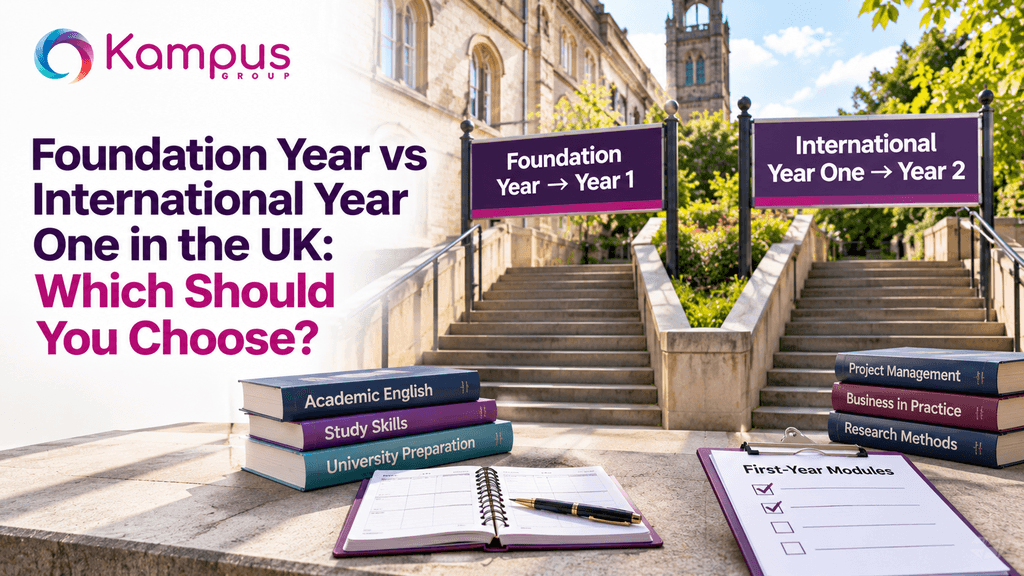
Choosing the right route into a UK university is an important decision for international students. While some applicants meet the direct entry requirements for an undergraduate degree, others may need additional academic preparation before progressing to their chosen course.
Two common options are a Foundation Year and an International Year One (IYO). Both provide alternative routes into undergraduate study, but they are designed for students with different academic backgrounds and levels of preparation.
A Foundation Year generally prepares students for the first year of a bachelor’s degree. An International Year One, on the other hand, is designed to help eligible international students begin university-level study at a level equivalent to the first year of an undergraduate degree, with progression to the second year after successful completion.
Understanding these differences can help you avoid choosing a pathway that is longer or less suitable than necessary.
What Is a Foundation Year in the UK?
A Foundation Year is an additional year of study designed to prepare students for undergraduate education. It is usually taken before the first year of a bachelor’s degree.
It helps students develop the academic knowledge, subject understanding, English language ability and study skills required for university-level education.
Foundation Years are particularly useful for international students whose previous qualifications do not meet the direct entry requirements for a UK undergraduate degree.
For example, a student whose secondary school qualification is not considered equivalent to the UK’s standard university entry qualifications may be asked to complete a recognised foundation programme before progressing to a bachelor’s degree.
Depending on the university and course, a Foundation Year may cover:
- Academic English and communication
- Mathematics and quantitative skills
- Research and study skills
- Subject-specific knowledge
- Critical thinking and academic writing
- Preparation for undergraduate assessments
How Long Does a Foundation Year Take?
A typical Foundation Year lasts one academic year. After successfully completing the programme and meeting the required progression conditions, students normally move into Year 1 of their chosen undergraduate degree.
This means the overall study period for a three-year bachelor’s degree is usually four years, although course structures and degree lengths vary.
Who Should Choose a Foundation Year?
A Foundation Year may be suitable for:
- International students whose secondary qualifications do not meet direct university entry requirements.
- Applicants who need to strengthen their knowledge in a particular subject area.
- Students changing academic direction and requiring subject preparation.
- Applicants who need additional support in academic English and university study skills.
- Students who are not yet ready to begin the first year of a bachelor’s degree.
What Is an International Year One in the UK?
An International Year One is a university preparation programme designed for international students who are academically prepared to study at undergraduate level but need additional academic or English language support.
Unlike a Foundation Year, an International Year One is generally equivalent to the first year of a bachelor’s degree.
Students study university-level subjects alongside academic English and study skills. After successfully completing the programme and meeting the progression requirements, they can normally progress directly into Year 2 of their chosen undergraduate degree.
For example, a student accepted onto an International Year One in Business may study subjects related to management, marketing, economics and academic skills. On successful completion, the student may progress to the second year of a related business degree.
The exact subjects depend on the programme and university.
How Long Does an International Year One Take?
An International Year One usually takes one academic year, although some providers offer different study periods depending on the intake, academic structure and English language preparation required.
Because it covers the equivalent of the first year of a bachelor’s degree, successful students normally progress into Year 2 rather than starting again in Year 1.
Who Should Choose an International Year One?
An International Year One may be suitable for:
- International students whose academic qualifications are close to the university’s direct entry requirements.
- Applicants who are ready for undergraduate-level study but need additional academic support.
- Students who want to progress into the second year of a bachelor’s degree after completing the pathway.
- Applicants who meet the programme’s subject requirements but need further English language or academic skills development.
Foundation Year vs International Year One: Key Differences
Although both pathways support international students entering UK universities, they differ in their academic level, entry requirements and progression routes.
| Comparison | Foundation Year | International Year One |
|---|---|---|
| Main purpose | Prepares students for undergraduate study | Provides an alternative route through the first year of a degree |
| Academic level | Below or preparatory to Year 1 undergraduate study | Equivalent to Year 1 undergraduate study |
| Typical duration | One academic year | One academic year |
| Entry requirements | Usually suitable for students who do not meet direct undergraduate entry requirements | Generally requires stronger academic qualifications |
| Progression | Usually progresses to Year 1 | Usually progresses to Year 2 |
| Academic content | Foundation subjects, English and study skills | Undergraduate-level subject modules, English and study skills |
| Suitable for | Students needing additional academic preparation | Students ready for university-level study with extra support |
| Typical degree structure | Foundation Year + three-year degree | International Year One + remaining years of the degree |
The main difference: A Foundation Year prepares you to begin a bachelor’s degree, while an International Year One covers the equivalent of the first year and can allow you to progress directly into Year 2.
Entry Requirements: Which Pathway Is Easier to Get Into?
Entry requirements vary between universities, pathway providers and subject areas. However, Foundation Year programmes generally have lower academic entry requirements than International Year One programmes.
Foundation Year Entry Requirements
International students may be required to provide:
- Recognised secondary school qualifications.
- Academic transcripts and certificates.
- Evidence of English language proficiency.
- A valid passport.
- Additional documents requested by the university or pathway provider.
Some Foundation Year programmes accept students with qualifications that do not meet the university’s direct bachelor’s degree entry requirements.
However, students must still meet the specific academic and English language requirements of their chosen programme.
International Year One Entry Requirements
International Year One programmes generally require stronger academic preparation because students are studying at undergraduate first-year level.
Applicants may need:
- Recognised secondary school qualifications with suitable grades.
- Relevant subject knowledge, particularly for specialist programmes.
- Evidence of English language proficiency.
- Academic transcripts and certificates.
- Other programme-specific documents.
For example, an International Year One in Engineering may require previous study in mathematics and physics, while a Business pathway may have different subject requirements.
It is important to remember that admission requirements are not the same across all universities. A student who qualifies for an International Year One at one institution may not automatically qualify at another.
Which Courses Can You Study Through These Pathways?
Both Foundation Year and International Year One programmes are available in several academic areas, although the options depend on the university and pathway provider.
Common subject areas include:
| Subject Area | Foundation Year | International Year One |
|---|---|---|
| Business and Management | Available | Available |
| Computing and Computer Science | Available | Available |
| Engineering | Available | Available |
| Law | Available at selected providers | Available at selected providers |
| Social Sciences | Available | Available |
| Accounting and Finance | Available | Available |
| Media and Communications | Available | Available |
| Biological and Life Sciences | Available at selected providers | Available at selected providers |
Some professional or regulated courses, including medicine, dentistry and certain healthcare programmes, have separate admission routes and may not offer a standard Foundation Year or International Year One progression pathway.
Students interested in nursing, pharmacy, medicine or other clinical professions should check the exact programme structure, accreditation and professional entry requirements before applying.
How Much Does Each Pathway Cost?
The cost of a Foundation Year or International Year One depends on the institution, subject, location and programme provider.
Students should consider both the pathway tuition fee and the cost of the undergraduate degree they will progress into.
Other expenses include:
- Accommodation
- Food and personal expenses
- Transport
- Books and learning materials
- Student visa application costs
- Immigration Health Surcharge, where applicable
- Other university or programme-related charges
A Foundation Year may increase the total cost of an undergraduate degree because it adds an extra year of study before the bachelor’s programme begins.
An International Year One may offer a shorter overall route because successful students can progress into Year 2. However, this does not automatically mean it is cheaper. Tuition fees for pathway programmes can differ considerably, and the cost of subsequent degree years must also be considered.
Always compare the full cost of the pathway and the remaining degree, rather than looking at the first-year tuition fee alone.
Can You Progress to a UK University After Completing Either Programme?
Yes. Both pathways are designed to provide progression into undergraduate degree programmes, subject to successful completion and the institution’s progression requirements.
However, progression is not always automatic.
Students may need to:
- Achieve the required overall grades.
- Pass all compulsory modules.
- Meet specific subject-module requirements.
- Satisfy any English language conditions.
- Meet attendance and academic conduct requirements.
- Fulfil any additional conditions set by the university.
An International Year One student will normally progress to Year 2 of the relevant degree after meeting the required conditions. A Foundation Year student will normally progress to Year 1.
Some programmes also have limited progression routes. Before accepting an offer, confirm the exact degree you can progress to and whether alternative courses are available if you do not meet your first choice’s progression requirements.
Which One Is Better for International Students?
Neither pathway is automatically better. The right option depends on your academic qualifications, subject knowledge, English language ability and intended degree.
Choose a Foundation Year If:
- Your current qualifications do not meet direct undergraduate entry requirements.
- You need more time to develop the academic knowledge required for your chosen subject.
- You are changing academic direction and need subject preparation.
- You want additional support before beginning a full bachelor’s degree.
- Your university recommends a Foundation Year based on your previous qualifications.
Choose an International Year One If:
- Your academic qualifications meet the programme’s entry requirements.
- You already have a suitable academic foundation in your chosen subject.
- You are ready to study at undergraduate first-year level.
- You want a pathway that can lead directly into Year 2 of a bachelor’s degree.
- You want to avoid repeating introductory undergraduate study, provided you meet the programme’s progression requirements.
Examples of UK Universities and Pathway Providers to Explore
Several UK universities and specialist pathway providers offer foundation and first-year international programmes. Availability, course names and progression arrangements vary by institution and intake.
| University or Provider | Pathway Options to Explore | Common Subject Areas |
|---|---|---|
| University of Exeter | International Foundation and International Year One routes through its pathway provision | Business, Engineering, Humanities and Social Sciences |
| University of Nottingham | Foundation and international pathway programmes | Business, Engineering, Science and Social Sciences |
| University of Leeds | International Foundation and undergraduate pathway options | Business, Science, Engineering and Social Sciences |
| University of Sheffield | International Foundation and pathway programmes | Business, Science, Engineering and Humanities |
| University of Sussex | International Foundation and International Year One options through pathway provision | Business, Computing, Engineering and Social Sciences |
| University of Birmingham | Foundation and international pathway options | Business, Engineering, Science and Social Sciences |
| INTO | University pathway programmes delivered with partner universities | Business, Computing, Engineering and Science |
| Kaplan International Pathways | Foundation and International Year One programmes at partner institutions | Business, Computing, Engineering and other disciplines |
The availability of a specific International Year One or Foundation Year depends on the university, pathway partner and subject. Students should verify the current course listing and progression destination before applying.
What Should You Check Before Accepting an Offer?
Before accepting either pathway, make sure you understand the conditions attached to your offer.
1. Confirm the progression university and degree
Check whether successful completion leads to the university and undergraduate course you actually want. Do not assume that every pathway provides access to every degree.
2. Check the progression grades
Find out the grades required to move to the next stage. Some courses may require higher marks in particular modules.
3. Compare the total duration
A Foundation Year followed by a three-year bachelor’s degree will generally take four years. An International Year One followed by the remaining two years of a three-year degree will generally take three years in total. Some degrees, including placement or integrated master’s programmes, have different durations.
4. Understand the teaching arrangement
Some pathways are taught directly by universities, while others are delivered by specialist pathway providers. Check where you will study, who will teach you and what academic support is available.
5. Review visa and immigration conditions
Students must meet the relevant UK Student visa requirements. Check that the institution is an authorised Student sponsor and that the programme is eligible for sponsorship. Your visa arrangements may also need to reflect progression between the pathway and degree stages.
6. Check accommodation and student support
Find out whether accommodation is available for pathway students and whether you can access the university’s library, academic support, wellbeing services and other student facilities.
Frequently Asked Questions
Is a Foundation Year the same as International Year One?
No. A Foundation Year prepares students for the first year of an undergraduate degree. An International Year One is generally equivalent to the first year of a bachelor’s degree and can allow students to progress directly into Year 2 after successful completion.
Which is better: Foundation Year or International Year One?
Neither is universally better. A Foundation Year is more suitable for students who need additional academic preparation, while International Year One is generally better for applicants who already meet the stronger academic entry requirements and are ready for undergraduate-level study.
Can I progress to Year 2 after a Foundation Year?
Normally, no. A standard Foundation Year prepares students to begin Year 1 of a bachelor’s degree. International Year One programmes are the route generally designed for progression into Year 2.
Can I study an International Year One without A-levels?
Some International Year One programmes accept alternative international qualifications, depending on the country, grades and subject requirements. Applicants should check the specific entry criteria of the university or pathway provider.
Is International Year One equivalent to the first year of university?
It is generally designed to be equivalent to the first year of an undergraduate degree. However, the actual modules, assessment standards and progression arrangements depend on the programme and university.
Can I change my course after completing a Foundation Year or International Year One?
This depends on the pathway provider and university. Some allow progression into related courses, while others restrict students to specific degree options. Check the permitted progression routes before enrolling.
Does an International Year One guarantee admission into Year 2?
No. Students must normally meet the required academic grades, pass compulsory modules and satisfy any other progression conditions. Progression is conditional rather than guaranteed.
Can international students apply for a UK Student visa for these programmes?
Eligible international students can apply for a Student visa when their programme and sponsoring institution meet the relevant requirements. The university or authorised pathway sponsor must issue the necessary Confirmation of Acceptance for Studies (CAS). Students should confirm the sponsorship arrangement before accepting an offer.
Is a Foundation Year more expensive than International Year One?
Not necessarily in terms of the pathway tuition fee. However, a Foundation Year usually adds an additional year before the bachelor’s degree, which can increase the overall cost of studying. Compare the full tuition and living expenses for the complete route.

Written by
Fimijoba Micheal Oladokun is an International Student Consultant, SEO Specialist and Technical Writer at Kampus Group Nigeria. He leverages data-driven insights to support strategic decision-making while guiding prospective international students through admissions and study abroad processes. He also creates clear, SEO-optimized technical content that enhances digital engagement and simplifies complex educational topics.
Get a free, unbiased assessment from a Kampus Group advisor — no obligation, completely free.
More on College Prep

Can Work Experience Help You Qualify for a UK Master’s?
Many international students assume that they need an excellent undergraduate degree result to gain admission to a master’s programme in the United Kingdom. Although academic qualifications are important, they are not alw
20 Oct 2026
What International Students Should Know About University Deposits
Receiving an admission offer from an overseas university is an exciting milestone. However, for many international students, accepting that offer comes with another important step: paying a university deposit. A universi
4 Sept 2026
How to Prepare for Group Interviews Used by Some Universities Abroad
Some universities abroad don’t rely only on written applications or one-on-one interviews. Instead, they use group interviews to assess how applicants communicate, collaborate, and think in real-time. For many internatio
25 Dec 2025