Received a Conditional UK University Offer? Here Is What to Do Next
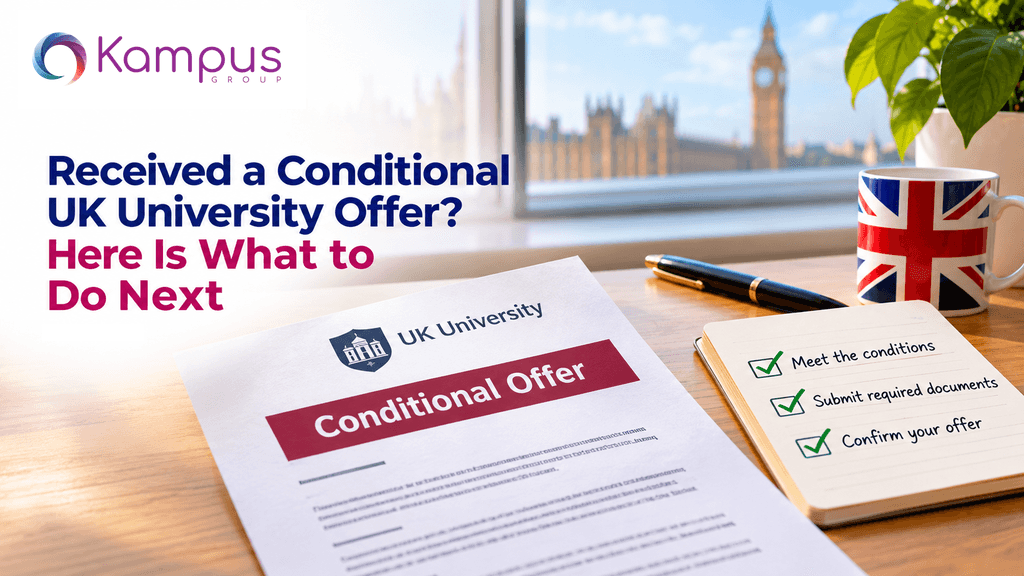
Receiving an offer from a UK university is an exciting step towards studying abroad. However, if your offer is conditional, you may still have some requirements to fulfil before your admission can be confirmed.
A conditional offer means that the university is willing to admit you, provided you meet specific conditions within the stated deadline. These conditions may involve submitting outstanding academic documents, achieving particular examination grades, providing English language test results or meeting other course requirements.
For international students, understanding what to do after receiving a conditional offer is important. Delays in submitting documents or misunderstanding the conditions could affect your admission, course start date and preparations for travelling to the UK.
This guide explains what a conditional offer means, the common conditions UK universities set and the steps you should take to move from a conditional offer to confirmed admission.
What Is a Conditional Offer from a UK University?
A conditional offer is an admission decision issued by a university when an applicant has been accepted subject to meeting certain outstanding requirements.
The university has assessed your application and determined that you are potentially suitable for the course. However, it needs additional evidence before it can confirm your place.
For example, a university may issue a conditional offer to a student who has applied for an MSc in International Business but has not yet provided their final undergraduate transcript or degree certificate.
The offer may state that admission will be confirmed once the student submits the outstanding documents and satisfies the university’s academic requirements.
A conditional offer is different from an unconditional offer, which means that the university’s stated academic and admission conditions have already been satisfied.
Why Do UK Universities Issue Conditional Offers?
Universities issue conditional offers for several reasons. In many cases, the applicant meets most of the admission requirements but has not yet provided all the evidence needed to finalise their admission.
Common reasons include:
1. Outstanding Academic Results
Some students apply before receiving their final examination results or completing their current qualification.
For example, an undergraduate applicant may receive a conditional offer while waiting for final A-level, WAEC or other recognised examination results.
2. Pending Degree Certificate or Transcript
Postgraduate applicants sometimes apply while they are completing their bachelor’s degree or waiting for their final academic documents.
A university may issue an offer subject to receiving evidence that the applicant has successfully completed their previous qualification.
3. English Language Requirements
A student may meet the academic requirements but still need to demonstrate the required level of English proficiency.
The university may ask the applicant to submit an approved IELTS Academic, PTE Academic, TOEFL or other accepted English language result.
4. Missing Supporting Documents
The university may need additional documents before confirming admission. These could include:
- Academic transcripts.
- Degree certificates.
- Reference letters.
- A personal statement.
- A CV.
- Professional certificates.
- Evidence of relevant work experience.
5. Additional Course Requirements
Some programmes have specific admission conditions. These may include relevant work experience, professional qualifications, prerequisite subjects or other evidence of academic suitability.
Conditional Offer vs Unconditional Offer: What Is the Difference?
Understanding the difference between these two types of offers will help you know where you stand in the admission process.
| Feature | Conditional Offer | Unconditional Offer |
|---|---|---|
| Admission status | Subject to outstanding conditions | Admission conditions have been satisfied |
| Academic documents | Some may still be outstanding | Required academic evidence has generally been accepted |
| English language evidence | May still be required | Required English conditions have been met or formally waived |
| Next step | Fulfil the outstanding conditions | Follow the university’s enrolment instructions |
| CAS eligibility | Not normally ready until relevant conditions are satisfied | May proceed to the university’s CAS assessment, subject to other requirements |
| Confirmation of place | Depends on meeting the conditions | University has confirmed the academic offer |
An unconditional offer does not automatically mean that a student has received a Confirmation of Acceptance for Studies (CAS) or a UK Student visa. There are additional steps before either is issued or approved.
What Should You Do After Receiving a Conditional UK University Offer?
Once you receive your offer, avoid delaying your next steps. Follow these actions to ensure you understand the requirements and make progress towards confirming your admission.
Step 1: Read Your Offer Letter Carefully
Start by reviewing the offer letter and any accompanying documents.
Pay attention to:
- Your full name and personal details.
- The university and course name.
- Your intended intake.
- Course start and end dates.
- Tuition fees.
- Deposit requirements.
- Outstanding admission conditions.
- The deadline for meeting those conditions.
Do not assume that every conditional offer has the same requirements. The conditions are specific to your application and programme.
If anything is unclear, contact the university’s admissions team or your authorised education representative for clarification.
Step 2: Identify Every Outstanding Condition
Make a list of all the conditions you must satisfy.
For example, your offer may require you to:
- Submit your final degree certificate.
- Provide an official academic transcript.
- Achieve a specified English language test score.
- Submit a reference letter.
- Provide evidence of relevant work experience.
It is important to address every condition rather than concentrating on only one.
If the university requires both a final transcript and an English language result, submitting just the transcript may not be enough to make your offer unconditional.
Step 3: Prepare the Required Documents
Gather the documents needed to satisfy the conditions.
If the university requests academic documents, ensure that they are clear, complete and issued by the appropriate institution.
For Nigerian applicants, this may include WAEC results, university transcripts, degree certificates or other recognised academic evidence, depending on the level of study.
If you need to submit an English language test result, confirm that the test is accepted by the university and that your score meets the required standard.
Where documents are not available immediately, contact the university to find out whether alternative evidence or an extension is possible.
Step 4: Meet the English Language Requirements
If your conditional offer requires an English language test, arrange the test early enough to meet the university’s deadline.
Commonly accepted tests include:
- IELTS Academic.
- PTE Academic.
- TOEFL iBT.
- Other approved English language tests, depending on the university.
Check the exact score required for your course. Some universities require minimum scores in individual components, such as reading, writing, listening and speaking, rather than relying only on the overall score.
Do not book a test based on general university requirements without checking your specific offer conditions.
Step 5: Submit Your Documents Before the Deadline
Once your documents are ready, submit them using the university’s specified method.
Some institutions accept uploads through an applicant portal, while others may require documents to be sent directly by the issuing institution or an approved verification service.
After submission:
- Check that the documents have been uploaded successfully.
- Keep copies of the documents you submitted.
- Save any submission confirmation.
- Monitor your email and applicant portal.
- Respond promptly if the admissions team requests additional evidence.
Submitting documents does not always mean that the university has accepted them. Wait for confirmation that your conditions have been met.
Step 6: Follow Up with the Admissions Team
If you have submitted all the required documents but your application status has not changed, contact the admissions team.
Ask whether the documents have been received and whether anything else is outstanding.
This is particularly important when your course start date is approaching. Universities may need time to review academic documents, verify qualifications and update admission records.
Step 7: Receive Your Unconditional Offer
Once the university has reviewed your evidence and confirmed that all academic and admission conditions have been satisfied, it may issue an unconditional offer.
This is an important stage because it confirms that the university has accepted the outstanding evidence required for your admission.
However, you may still need to meet other requirements, such as paying a tuition deposit, completing pre-CAS checks or providing additional information before the university can issue your CAS.
What Happens After Your Conditional Offer Becomes Unconditional?
Receiving an unconditional offer is a significant step, but it is not the end of the admission process.
International students usually need to complete several additional stages before travelling to the UK.
1. Pay the Required Tuition Deposit
Some universities require international students to pay a deposit before proceeding with the CAS process.
The amount varies by university and course. Your offer letter or university payment instructions should explain the required amount, payment deadline and available payment methods.
Always pay through the university’s official payment channel or an authorised payment provider.
2. Complete the Pre-CAS Process
Many UK universities conduct pre-CAS checks before issuing a Confirmation of Acceptance for Studies.
These checks may involve:
- Reviewing your academic history.
- Confirming your course choice.
- Checking your financial arrangements.
- Reviewing your immigration history where relevant.
- Conducting a credibility interview.
- Requesting additional supporting documents.
Not every university follows exactly the same process, so applicants should follow the instructions provided by their institution.
3. Receive Your Confirmation of Acceptance for Studies (CAS)
A CAS is an electronic record issued by a licensed UK Student sponsor to support a Student visa application.
It contains information about your course and sponsorship and includes a unique CAS reference number.
You cannot apply for a UK Student visa using only a conditional or unconditional offer letter. You need a valid CAS from your university or other licensed Student sponsor.
4. Prepare Your UK Student Visa Application
After receiving your CAS, you can prepare your Student visa application, provided you meet the other immigration requirements.
Depending on your circumstances, you may need:
- A valid passport.
- Your CAS reference number.
- Evidence of sufficient funds, where required.
- Evidence of English language ability, where applicable.
- Academic documents, where required.
- Tuberculosis test results, if applicable.
- Other supporting documents requested by UK Visas and Immigration.
You should also check the current visa application fee, Immigration Health Surcharge and financial requirements before applying.
5. Complete Biometrics and Await a Decision
Follow the instructions for submitting your visa application and attending your biometric appointment, where required.
You may also be asked to provide additional documents or information.
Do not make non-refundable travel arrangements until you have received the necessary immigration decision and confirmed your travel arrangements.
What If You Cannot Meet Your Conditional Offer Requirements?
Sometimes applicants experience difficulties meeting their offer conditions before the deadline.
For example, a student may not receive their final transcript on time, may not achieve the required English language score or may be unable to obtain a particular supporting document.
If this happens, contact the university immediately.
Depending on the circumstances, the university may:
- Allow additional time to submit the required documents.
- Consider alternative evidence.
- Accept an approved alternative English language test.
- Offer a different course or entry route.
- Defer the application to another intake.
- Withdraw the offer if the conditions cannot be met.
These options are not guaranteed. The university will decide based on its admission policies and the circumstances of the applicant.
It is better to communicate early than to wait until the deadline has passed.
Can You Change Your Course After Receiving a Conditional Offer?
In some cases, yes. However, changing your course depends on the university’s policies, the availability of places and whether you meet the entry requirements for the alternative programme.
For example, a student who receives a conditional offer for MSc International Business may want to switch to MSc Project Management.
The university may need to reassess the applicant’s academic background, professional experience and suitability for the new programme.
If you want to change your course, contact the admissions team before making payment or proceeding with your CAS arrangements.
Do not assume that a course change will automatically be approved or that your existing offer conditions will remain the same.
Common Mistakes to Avoid After Receiving a Conditional Offer
Receiving an offer can create excitement, but applicants should remain organised throughout the remaining admission process.
Avoid these common mistakes:
1. Ignoring the offer conditions
Some students focus on the offer itself without checking what they still need to provide. Read the full offer letter and identify every outstanding requirement.
2. Missing submission deadlines
Universities may withdraw offers or move applicants to a later intake if conditions are not met within the required period.
3. Submitting incomplete documents
Ensure that documents are clear, accurate and submitted in the format requested by the university.
4. Assuming a conditional offer guarantees a CAS
A conditional offer does not guarantee CAS issuance. You must first satisfy the university’s admission and sponsorship checks.
5. Paying tuition fees without verifying payment details
Use official university payment instructions and verify any payment request that appears unusual.
6. Making travel arrangements too early
Wait until your visa has been approved and your travel arrangements are confirmed before committing to non-refundable bookings.
7. Providing inconsistent information
Ensure that your academic records, application details, passport information and supporting documents are consistent and accurate.
Conditional Offer Checklist for International Students
Use this checklist to keep track of your progress after receiving a UK university offer.
- Read the conditional offer letter.
- Confirm the course, intake and start date.
- Identify every outstanding admission condition.
- Check the deadline for submitting documents.
- Obtain outstanding academic certificates and transcripts.
- Complete the required English language test, if applicable.
- Submit all documents through the correct channel.
- Confirm that the university has accepted your documents.
- Receive your unconditional offer.
- Pay the required tuition deposit.
- Complete pre-CAS checks and any credibility interview.
- Receive your CAS.
- Prepare and submit your Student visa application.
- Complete biometrics and any other visa requirements.
- Make travel and accommodation arrangements after the necessary approval.
Frequently Asked Questions
Does a conditional offer mean I have been accepted into a UK university?
It means the university is willing to offer you a place, provided you meet the stated conditions. Your admission is not fully confirmed until the university has accepted the required evidence and updated your offer status.
How long does it take to change a conditional offer to an unconditional offer?
The time varies between universities. It depends on how quickly you submit the required documents and how long the admissions team takes to review and verify them. Contact the university if you have been waiting longer than its stated processing period.
Can I pay my tuition deposit with a conditional offer?
Some universities allow students to pay a deposit while their offer is still conditional, while others may require specific conditions to be met first. Follow the payment instructions in your offer and confirm the university’s policy before paying.
Can I apply for a UK Student visa with a conditional offer?
Generally, a conditional offer alone is not sufficient. You need a valid CAS from a licensed Student sponsor before applying for a Student visa. The university will normally need to complete its relevant admission and sponsorship checks first.
What happens if I fail to meet my conditional offer requirements?
The university may offer an alternative course, consider an extension, defer your admission or withdraw the offer, depending on its policies and your circumstances. Contact the admissions team as soon as you realise you may not meet a condition.
Can I receive an unconditional offer without IELTS?
Yes, if the university accepts another form of English language evidence or formally grants an exemption under its policy. However, you must satisfy the university’s English language requirements before your admission can be confirmed.
Can I defer my UK university offer to another intake?
Some universities allow applicants to defer their offers, but approval depends on the course, availability and institutional policy. You should request a deferral from the admissions team rather than simply failing to meet the original intake deadline.
Does an unconditional offer guarantee a UK Student visa?
No. An unconditional offer confirms that the university’s admission conditions have been met. A Student visa is a separate immigration decision made by UK Visas and Immigration. Applicants must meet all applicable visa requirements.
Can I receive a CAS before paying my tuition deposit?
This depends on the university’s CAS policy. Some institutions require a deposit before issuing a CAS, while others may have different arrangements. Check the university’s instructions for your course and intake

Written by
Fimijoba Micheal Oladokun is an International Student Consultant, SEO Specialist and Technical Writer at Kampus Group Nigeria. He leverages data-driven insights to support strategic decision-making while guiding prospective international students through admissions and study abroad processes. He also creates clear, SEO-optimized technical content that enhances digital engagement and simplifies complex educational topics.
Get a free, unbiased assessment from a Kampus Group advisor — no obligation, completely free.
More on Preparation

Best UK University Courses for Students Interested in Creative Careers
Not every student wants a career in banking, engineering, medicine or traditional office-based professions. Some are more interested in designing products, creating digital content, developing visual concepts, producing
11 Nov 2026
Foundation Year vs International Year One in the UK: Which Should You Choose?
Choosing the right route into a UK university is an important decision for international students. While some applicants meet the direct entry requirements for an undergraduate degree, others may need additional academic
6 Nov 2026
Best Canadian Universities for International Students Interested in Healthcare
Canada is an attractive destination for international students who want to build careers in healthcare, medical research, nursing, public health and other health-related fields. Its universities offer a wide range of und
6 Nov 2026